An English research corpus on the chisel and carpentry-tool blacksmiths of Edo and Tokyo, their lineages, marks, guilds, and fate, assembled from Japanese primary and secondary sources, most of them never before available in English.
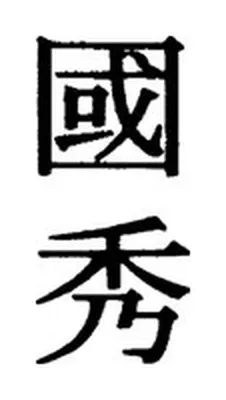
正芳清忠市弘左久作千代鶴是秀弘正左茂弘國弘義廣
A living work in progress. This register exists to keep disappearing knowledge alive: Tokyo's carpentry-tool trade has all but vanished, and much of what is gathered here was recovered from dead websites and from Japanese sources never before rendered in English. It will contain gaps and mistakes, and a careful human Japanese-to-English translation and review is in progress; treat the readings and wording in the meantime as a working draft. Corrections, additions, and first-hand knowledge are warmly welcomed; every claim carries a citation precisely so it can be checked and challenged.
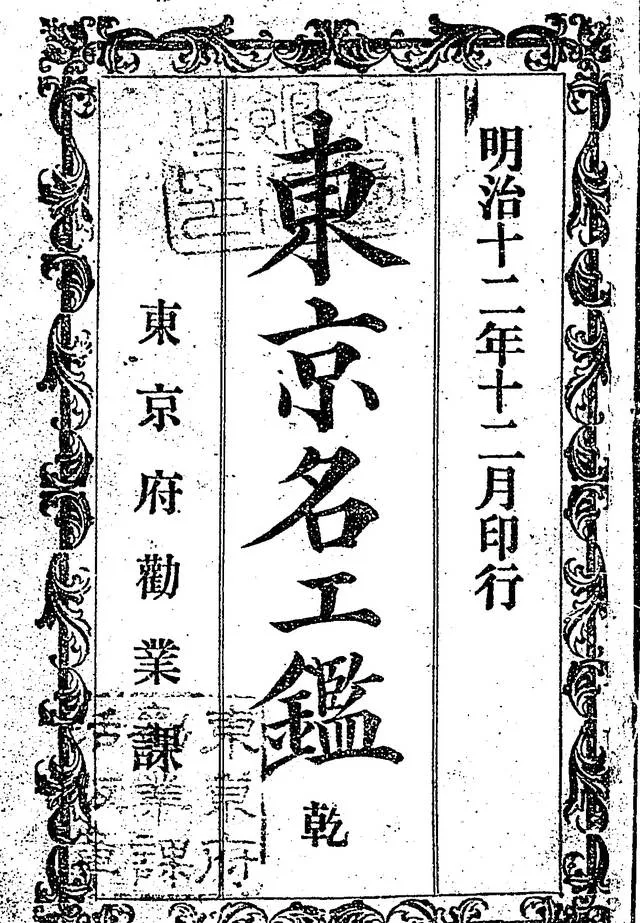
東京名工鑑 · Tōkyō Meikō Kagami, 1879, the Tokyo government’s own register of master craftsmen (Prefectural Industrial Promotion Section). The earliest documentary ancestor of a work like this one: it lists the early-Meiji smithing trades, gun-, machine-, file-, and saw-smiths, a generation before the chisel names became famous. Public domain, National Diet Library.[13]
Tokyo was one of only eleven true blade-making districts left in Japan by 1960, alongside Sanjō, Miki, and Sakai, yet it is the one whose smiths are vanishing from the record.[24] Mid-Shōwa carpenters spoke of Tōkyō dōgu, "Tokyo tools," as a recognized class of goods. As a production district, Tokyo has now essentially disappeared,[25] and with it the names of the people behind the marks.
The Japanese record of these smiths survives in scattered, mostly untranslated places: the tool-history essays of the Suzuki Kanamono shop,[1] the research bulletin of the Takenaka Carpentry Tools Museum,[8] Meiji trade directories digitized by the National Diet Library,[13] dealer knowledge preserved on Shift-JIS-era shop websites,[5] and the memories of a handful of dealers still trading in Sumida and Setagaya. Nothing comparable exists in English. This register gathers it.
About the author
I’m a bespoke trim carpenter working in high-end custom theatre design and fit-out, and I use these tools in my daily work. This register is a personal venture, the product of a working craftsman’s fascination with the craftsmanship and the history behind the blades, not an academic study. Its only aim is to gather, cite, and preserve what is otherwise scattered across dealer lore, out-of-print books, and fading memory; where accounts conflict or a reading is uncertain, I’ve tried to say so plainly.
Structure of the craft
The lineages of Tokyo chisel smithing
Tokyo chisel smiths fall into four broad streams, per the Suzuki Kanamono genealogies:[1]
1 · The Kunihiro–Yoshihiro line 國弘義廣
Founded by Tanaka Watakichi (田中和多吉, b. Bunsei 3 / 1820), who came from Echigo Sanjō to Edo Hatchōbori. Tradition holds Kunihiro and Yoshihiro were brothers, "chisels are Kunihiro, planes are Yoshihiro", but Suzuki's own analysis of the Kaibutsuden (怪物傳, whose author interviewed the smiths directly) rejects the brothers theory: Yoshihiro was Tanaka Nikichi (田中仁吉, b. Koike, Sanjō; d. 1896), trained under 鈴田の定 of Nihonbashi, his line running to a 3rd generation; Kunihiro's own pupils included 國道 (Kunimichi), 國貞 (Kunisada), 國義 (Kuniyoshi), 宗近 (Munechika), and 國行 (Kuniyuki).[1] The plane line was known as 田圃の義廣 (Yoshihiro "of the rice paddies"), paired with 三ヶ輪 (Mikanowa) as its adze-maker,[77] and the Takenaka museum's blade tests rate an 義廣 plane among the hardest edges it has measured.[74]
The 國弘 · 義廣 house, diagrammed
"Chisels are Kunihiro, planes are Yoshihiro": one Sanjō-born Hatchōbori house, not two brothers, per Suzuki.
2 · The Ishidō–Chiyozuru line 石堂千代鶴
The sword-smith aristocracy of tool making: the Edo Ishidō house, appointed shogunal sword smiths (お抱え刀工) in 1721 (Kyōhō 6), began converting to tool smithing in Meiji 3 (1870), ahead of the 1876 sword ban, producing Ishidō Hideichi (石堂秀一) and the most celebrated tool smith in Japanese history, Chiyozuru Korehide (千代鶴是秀). See the Chiyozuru & Ishidō file.
3 · The Edo cutlery-smith line 江戸刃物鍛冶
Blade smiths of the old Edo cutlery trade who moved into carpentry tools as the city burned and rebuilt: every rebuild demanded tools alongside timber.[25] The Hisasaku memoir's genealogy chart (its p.8, the fullest map of this stream) traces the whole line from 清弘 (Kiyohiro, a hereditary name at Ōkawabata from mid-Edo): the 清治 branch producing 千代弘, 左勝廣, and 清忠 (Kiyotada); the 清長 branch producing 市弘 (Ichihiro) and 長弘 (Nagahiro); and the 久弘 (梅吉) branch producing 左久弘 and its offshoots 左久作・左久清・左久喜; 孝弘 and the instrument-blade smith 国領 form two further 清弘 branches. Together, this means most of Tokyo's celebrated chisel names sit inside this one stream. The surviving representative is the Hidari-Hisasaku forge (左久作) in Tsukishima.[53]
The 清弘 stream, diagrammed · ★ = has a register entry · † = line extinct or closed
The four working marks descend to houses the register documents: 清忠 Kiyotada → the Shimamura house · 市弘 Ichihiro → the Yamazaki house of Nakano · 長弘 Nagahiro → the Tanaka house of Edogawa · 左久作 Hidari-Hisasaku → the Ikegami house, Tsukishima, the last of the whole stream still forging. Redrawn from the genealogy in An Edo Blacksmith's Order Book (Ikegami, 1992), pp.8–9.
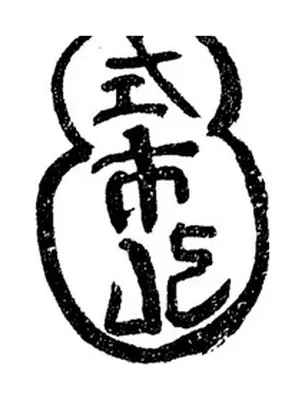
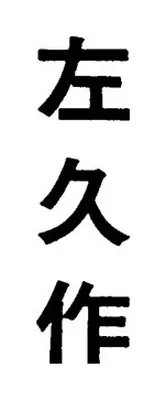
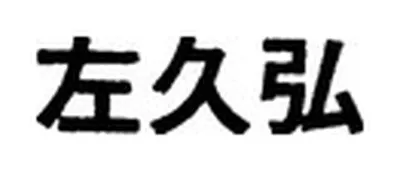
Why so many marks begin with 左 (Hidari). The 左 prefix marks a Tokyo smith's own work, and two accounts of its origin survive, which may belong to different moments. Per the Suzuki genealogy and the Hidari-Hisasaku forge, a smith added the 左 on going independent as a custom order-smith (誂え鍛冶). Per the Inoue tool house it was also defensive: after a Niigata wholesaler registered the smiths' plain marks (市国 Ichikuni, 市弘 Ichihiro, and others) without permission and charged a royalty on every blade sold, the smiths registered fresh 左-prefixed marks they were free to use. Either way 左市弘, 左久作 and 左久弘 are the makers' own marks, not separate hands.[2][20]
4 · The independents
Smiths outside the main houses, such as Senju's Masayoshi (正芳). (Tsukishima's Kiyotada (清忠), long grouped here with Masayoshi as "the forgotten," is placed by the Hisasaku memoir's genealogy inside the Edo cutlery-smith stream, the 清弘→清治 branch, as the last deshi of 千代弘.)[53]
+ The Ichimonji line of Komatsukawa 一文字
Yokosaka Santarō (横坂三太郎, mark Ichimonji) of Komatsukawa trained Hasegawa Fujisaku (長谷川藤作) and Yamazaki Nobuji (山崎信次, mark Mitsuki 光月), a fifth branch of the map. See the Fujisaku forge.[2]
The 一文字 · Yokosaka line, diagrammed · ★ = has a register entry
Yokosaka's one-mark house branched into Fujisaku (five marks, see the case study) and 光月. After Suzuki keifu 2.
The marks themselves
A gallery of the registered marks
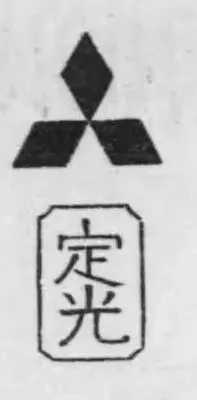
A mark (銘) was a registered trademark, the drawn form filed with the Patent Office. Recovered from the 商標公報 gazettes, these are the actual marks behind the register that follows; the table maps each back to the smith or house that forged or owned it.[64] Two early registrations recovered from the 商標大全 and image-verified against its pages anchor the Tokyo timeline: 田中國吉 of 京橋新榮町 first filed reg 2101, chisels, axes, and knives, about 1889 (renewed 1903), the earliest Tokyo carpentry-tool trademark yet found; and the 定光 / 正利 house (川口惣吉, 神田元岩井町) was already registering its three-diamond mark by 1908 (reg 32237), thirteen years before the 1921 marks it is known by.[63] The registry had a darker side too: a Niigata wholesaler trademark-squatted several Tokyo smiths' marks (市国, 市弘 and others) and charged a royalty on every blade sold, which is why so many smiths later registered defensive 左-prefixed marks (see the lineages above).[20]
Marks (銘) were often owned by wholesalers (問屋銘), not smiths; one forge could produce under half a dozen names. This register maps mark → person, recovered from Japanese sources in August 2026. Rows tagged provisional carry a core attribution not yet firmly sourced, treat them with caution.
I b. 1890 (Hiyoshi, Yokohama) · II 1924–2011; forge closed June 2006, demolished the same year
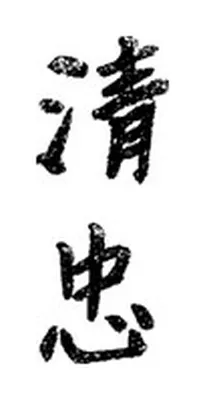
"Japan's best chisel." I, per Suzuki, b. Meiji 23 in Hiyoshi, apprenticed at 15 to a Nagoya farm-tool smith, then self-taught his way into chisels; per Hisasaku III he was also the last deshi of the Edo blade smith 千代弘 (the 清弘→清治 line); his shops ran Asakusa Hashiba → Nihonbashi Okazaki-chō → Tsukishima (a dealer chart says "Kayabachō"). The first generation was proclaimed best in a test of Tokyo's top four smiths by the Niigata metallurgist Iwasaki Kōsuke (岩崎航介), who held that Tokyo's smiths were then Japan's best, making Shimamura, by his test, the best chisel smith in Japan. II, an atomic-bomb survivor (stationed near Hiroshima, 1945), priced his tools deliberately within reach of working carpenters. A first-hand 2006 farewell interview (Knife Magazine, 東京鍛冶の系譜 4) records the end: after Kōzaburō's hospitalization his son Kiyotada (清忠, the mark is literally the son's given name) carried the main share of the work, and the forge closed in June 2006, ending a ~70-year career begun at 13; the interviewer notes the technique passed to the son, so late pieces (~2003–06) are largely the son's hand. Period strata from the same interviews: wartime = material-starved; early postwar, before he adopted tempering (he later settled on batch oil-tempering as his 決め手), = over-hard and chip-prone; mid-career "peak" pieces are the target. He admitted economizing file-finish where cutting is unaffected, geometry, not polish, is the tell (plainer than an equivalent Ichihiro is normal). Twelve associated marks (別清忠, 特清忠, 国行…, plus a reversed-order 忠清 variant); the brand itself belongs to the tool store Suiheiya (水平屋). The 清忠 mark was registered in 1951 by Takahashi Ginpei (高橋銀平) of Asakusa Senzoku-chō 1-3 (Class 8 edge tools), a named holder for the brand.[64] Post-succession Kiyotada-stamped tools are forged in Niigata (large plane blades by a Niigata smith) with the identical stamp, ask the store which smith made a piece; authenticate chisels by neck geometry and mirror-symmetric file marks. Retailer tell on originals: white-oak handles = sold via Tsuchida, red-oak = via Suiheiya (first-hand, Covington). Chapter in Tsuchida's Hamono-tarubeku.
"Tokyo's No. 1 chisel smith", the mukōmachi master. The 東一 prefix is read "Tōichi" (per the Inoue tool house[20]) or "Azuma-Ichi", either way "Number One in the East"; dealers recall him as one of the very few who charged more than Hidari-Ichihiro. Independent 1930 at 23; the last to keep every operation by hand as the trade mechanized; forged 37 years until a 1967 cerebral thrombosis. Took exactly one apprentice. Died 1982, at 74, per the Suzuki Kanamono profile. Vintage pieces to ¥1,000,000; a 東一正芳 plane sold ¥435,000 in 2022.
The first generation's only apprentice (entered 1954 at 16); received the name at ~28 after the master's stroke; in later years ran the Senju tool shop rather than forging. Died 2014 (memorial in Kezurou-kai bulletin 70). Elder brother: plane smith Yuzawa Hideo (宝龍斎秀延, Adachi → Tochigi, d. 2008), who reportedly fire-forged his kanna.
I d. 24 Jan 1941 · II 1912, d. by 2004 · III 1938–2006
Family from Teradomari, Niigata. I apprenticed under Shimamura Jirokichi (Honjo), independent in Nakano after the 1923 quake; II was I's younger brother; III (Shōzō, b. 3 Jan 1938) worked as a brother team with 明倫 (Hirotsune per later furigana; one 1993 source prints Tsunehiro) at the forge, gave the long 住と建築 interviews (1996–98), and taught metallurgy at Tokyo Tech (confirmed, plus Geidai and Kōgakuin teaching). The 市弘 mark passed through wholesaler hands (名取正勝商店 claimed it by 1941; a Shōwa 24/1949 trademark conflict, counterfeits surfacing in Niigata, was answered by registering the mirror-written 鏡文字 左市弘 in 1950, reg. 390598, filed by the smith himself, Yamazaki Isamu (山崎勇), at Nakano Sakae-chō 1-10[64]; that mark was itself later registered without permission and resold three times before settlement). The name passed to Shōzō in late 1986/87, by the family's own account from the still-living II, by Suzuki's account after his death; II was dead by 2004, the exact year unrecorded (the earlier "~1996" here was unsupported). Genuine stamp: gourd outline with crescent moon; sen-cut ura with intact oxide skin. A single II-generation chisel (by Yamazaki Isamu) drew a ¥3,000,000 valuation on a TV appraisal programme, a measure of the tier's standing.
Founded spring Taishō 12 (1923) by Ikegami Kisaku (b. 1899, Uozu, Toyama; placed at age 10 by the Yotsuya tool dealer 加藤徳兵衛), a marriage-branch of the 左久弘 house: he trained under the 2nd-gen 左久弘 Kashiwagi Masatarō and married Masatarō's third daughter, taking the branch-name (memoir and Suzuki genealogy agree; an earlier reading placing his training under the 3rd gen was a transcription error). 2nd gen Takanobu (b. Feb 1924) made tools for the Yakushi-ji west-pagoda rebuild under Nishioka Tsunekazu, and wrote An Edo Blacksmith's Order Book (1992, ed. Akioka Yoshio). 3rd gen Yoshiyuki (b. May 1955), among the last of the Edo custom forges; sole inherited secret: the forge-welding flux recipe. Tokyo wholesale channel (2026 directory mining): the 左久作 mark was distributed by Naohira Honten (直平本店, Arai Naojirō) of Kyōbashi Nishi-Hatchōbori 3-13, alongside 左久弘 and 左行弘; the linked Koizumi forge (小泉鍛冶工場, 小泉佐右衞門) at Sendagaya is a candidate co-maker. The 左久作 trademark (reg 389384) was held by Ikegami Takanobu (池上喬庸), the second generation, at Tsukishima, registered 1950, renewed 1977.[64] The parent 左久弘 house is documented earlier still: its second generation, 柏木政太郎, registered a 鑿及鉋 (chisel-and-plane) mark in his own name in 1910 (reg 39125, a gourd-frame device, from 本所相生町), six years before the house’s 1916 左久弘 trademark, and image-verified against the register page.[63]
Identity triple-confirmed (japan-tool, hama-net, Kurashige). Per Suzuki the first 長弘 was Tanaka Akijirō (田中秋二郎, Yoita-born), who trained under his elder brother, a blade smith at Makuhari, Chiba; the house sits in the 清弘→清長 branch of the Edo cutlery-smith stream per the Hisasaku genealogy. Ichirō was born Taishō 13 (1924), the same year as Ikegami Takanobu. The third peer of the Kiyotada/Ichihiro tier; retired once, returned at his wife's persuasion; White Steel #1 "very Tokyo," guild stamp above the mark; special-order chisels at Ichihiro prices; sets now ¥240–250k retail. The Hōryūsai art-name is shared with 宝龍斎秀延 (Yuzawa Hideo).
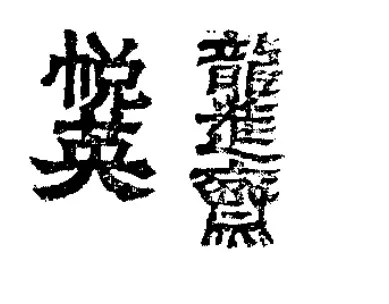
First-generation maker of the famous 男盛 Tokyo plane, Blue Steel #1, pine-charcoal forged, water-quenched, rated by one dealer at or above Usui Kengo's Kenmei. A recovered HOKUTO dealer study of the 堤鉋製作所 (Tsutsumi Plane Works) identifies Tomoichi (reading confirmed つつみともいち) as the 初代男盛 and as 龍進斎悦英 himself, active mainly in Shōwa, famous across Kantō, with sibling marks including 雲龍, 寿, 松寿 (Shōju), 瑞祥, 天心, and 龍眠; fire-forging was done by 堤せいじ, who lost the use of an arm in the war and forged one-armed after it (why postwar pieces look rougher); a third generation continued forging 男盛, and a dealer label elsewhere marks late pieces 龍進斎悦英(三代目). A Saitama lineage study instead traces 龍進斎悦英 to Tsutsumi Densaku (堤伝作), a third-generation Sanjō smith whose line was founded by a pupil of the swordsmith 龍眠斎兼行, prospered on 1923-quake reconstruction, moved to Kanda and turned wholesaler, with blades also forged by 吉川栄造 (mark 吉弘) and a 2nd-generation 悦英 (堤政悦), and names Tomoichi of Itabashi as his relative (親戚筋). The two accounts conflict on which 堤 "was" Etsuei; they would reconcile if 龍進斎悦英 is the workshop's hereditary art-name held across generations, but that reconciliation is this register's inference, not a source's. The house mark is now dated: 堤定作 registered its 悦英 mark in 1919 (reg. 105744, Class 8, planes & saws) at Kanda Mitoshiro-chō 1-15, twenty-two years before the Kanda wholesale house recorded in 1941. Earlier still, the house registered three planes on a single day, 17 Feb 1908, 堤式溝挽鉋 (reg 7838), 堤式面取鉋 (reg 7839) and 堤式小溝挽自在鉋 (reg 7840), jointly with a partner recorded as 頓野乙吉 (reading provisional); these are the first dated registrations for the 堤/男盛 house.[65][63]
One of the two smiths Korehide himself called "my teachers" (私の師匠たちです), the other being 国秀 of Asakusabashi (quit ~1935; plausibly the same mark lineage as the 國秀 that Fujisaku later OEM-forged for the Asakusabashi wholesaler Morihei, though that chain is unconfirmed). Per Suzuki he first made his name in the Meiji 30s as a precision machine-and-hardware smith at Honjo 千歳町 (the Hayashi-chō address here is the registration record's), converting to blade smithing afterward, a 1913 utility model, reg 28194 (戸張式機械作里, a machine rabbet plane), documents that machine-and-hardware phase and predates his 1921 mark[65]; quit ~1930. Yoita-descended per the town history (土肥助右衛門 → 土肥惣蔵 → 碓氷奥助), continued by 山崎久次郎・皆川峯造・相澤太七. The related 助丸 (Sukemaru) mark, often taken to be one Tokyo smith, "Usui Sukemaru, 伝統工芸士", is in fact a multi-generation Yoita (Niigata) line: 3rd-gen Usui Kinsaburō (碓氷金三郎, d. Dec 2009, aged 92, awarded the 黄綬褒章), 4th-gen Usui Yoshio (碓氷淑郎, b. 1947), who holds the 助丸 trademark. "碓氷助丸" is a generational mark, not a personal name; whether the Yoita 助丸 line actually descends from this Tokyo-Honjo house is unconfirmed. Most chisels now sold under either mark are not the founders' own hand.
Master of Yokosaka Masato (who trained under his 国貞 mark); ran a second works via Urayasu/Makuhari; Sano Katsuji ("Hyōbu" 兵部, next row) also worked in his shop.
Born in Yoita; trained under Tanaka Gorōji (田中五郎次, father of the 2nd-gen 田中昭吾, making Sano and Shōgo fellow-apprentices); after a war interruption worked as a journeyman (渡り職人) under Tokyo plane masters 尾島功大, 渋木文明, and 山崎春吉; independent at Takinogawa in 1955, planes his core trade plus carving chisels and kogatana. The 兵部 name reaches back to his home Yoita in the late Edo period per Suzuki. He forged five wholesaler marks (国明・運慶・正俊・宝凰・天仙寿) and, briefly, even a 千代鶴-branded line. The 兵部 mark afterward passed via a Niigata wholesaler to Inoi (猪井) of Sanjō, and 兵部-marked planes today are forged by Nakano Takeo (中野武夫) of Yoita, one mark, three hands, two trades; most 兵部 sold is not Sano's own.
A Tokyo plane smith, named by Suzuki in October 2008 as one of the capital's last four carpentry-tool smiths (with も作 Kanda Kikuo, 長弘 Tanaka Ichirō, and Hidari-Hisasaku III), and one of only two plane smiths among them. Otherwise undocumented in this corpus, a research target.
Morning-glory engraving referencing the Iriya fair (a Hokuto-recorded piece, dated 1956). Caveat: a dealer lists a 山崎春吉 of Makuhari under the mark 峰寿; whether the marks 釋尊/是麿 and a "tigers in bamboo" kanna belong to this same smith is unverified.
One of several smiths who forged Unju-brand (千代鶴運壽) planes for the wholesaler; his own mark was 松雲 (Shōun). At the 輝明鉋刃製作所 in Adachi per the 1967 cooperative roster. (Fellow Unju forgers: Yamaguchi Yūtarō, Tanaka Shōgo 田中昭吾.)
3rd-generation Chiyozuru (千代鶴延國). Korehide taught him personally from 1925 but, as with everyone after Taishō 7, did not take him as a formal disciple, later naming him successor. His early plane mark (from ~1922, Yokohama) was the wholesaler brand 久國; he also signed 三水 and 無我. Founding chairman of the Tokyo plane-makers' cooperative (東京都鉋製造協同組合) in the 1950s. Tsuchida's first-hand chapter dates his death to the end of the Shōwa 40s (~1973–74; an earlier account's "1978" and the Suzuki site's "1973 retirement" likely both reflect this) and records the aftermath: his sons Ochiai Giichi (義一, eldest, forging) and Ochiai Wakichi (和吉, second son, cold work, living in Kawasaki) continued the forge at the Meguro workshop-residence, whose gate plate 「三代目千代鶴延国、落合宇一」 had been brush-written by Korehide himself; Giichi's health failed by 1982, and Wakichi worked on alone until a fire, January 1992 per Suzuki, deemed arson by the fire department per Tsuchida, destroyed the workshop; the line ended without successor. (On the death year the two biographies conflict: Tsuchida, first-hand, "end of the Shōwa 40s"; Suzuki gives retirement 1973 and death 1978 "at 72," though that page's ages are internally inconsistent.) Per Korehide's testament Uichi had inherited all of his master's smithing tools. (A 1973 Labour-Minister / 1974 Sacred-Treasure honour sometimes attributed to him is withdrawn here: no award appears in either biography.)
The 圓山 (Maruyama) house of Urawa, Saitama. Per the Suzuki genealogy the first 孝弘 was the last disciple of the 清弘 line, thus a brother-disciple of the 久弘 founder Kashiwagi Umekichi (梅吉), not a branch of the 左久弘 line, and was known as a curved-blade smith (曲物鍛冶), selling from Kantō northward with a particular Hokkaidō market; the house ran to a second-generation 孝弘 before closing, successorless, in the Shōwa 40s. (The memoir's own chart confirms this; Suzuki's rendering 曲者 was its misreading of the book.)
A dealer mark-list associates him with Hidari-Hisahiro II as a "wandering smith," said to have worked for the wholesaler Tenmaiya (天満屋) and in Masayoshi I's workshop; the lineage tie is a dealer attribution, not confirmed in the primary Hidari-Hisasaku record. Not to be confused with 左茂弘.
宗秋 is a swordsmith name: the 1st generation trained under the Nanbu (Iwate) swordsmith Shigemori (重守) and was granted it in the late Edo period; the 2nd generation opened a Tokyo forge in 1912 (Taishō), relocating to Tateishi in 1928. It is a general 江戸打刃物 house, kitchen knives, chisels, planes, even katana (with temple commissions at Nikkō), applying sword-forging technique, not a chisel specialist or "the last chisel forge." 4th-generation head Yaegashi Junichi (八重樫潤一, b. 1952), a Katsushika Traditional Craftsman; forges two-man in Shirogami #1 without a spring hammer, with apprentices including Konuma Ryōsuke (documentary 明日への扉 #164, 2023).
清 b. ~1930 (a dealer chart: 1920) – ~2018; 斎藤 b. 1945
A carving-chisel (彫刻鑿) house older than the dealer charts suggest: per Muramatsu's 1978 道具曼陀羅 essay[71] the smith line ran five generations: grandfather Takiguchi Shinkichi (滝口信吉) was the third, who converted the house from miya-daiku tools to carving chisels; the fourth (六之助) was the first to sign 小信; Kiyoshi (清) was the fifth-generation smith and second 小信 (hence also styled "3rd-generation" carving smith). Moved from Shitaya-Kanasugi to Tanashi in 1949, the same address the 2004 打刃物職人 chapter records. Steel Aogami #2 (constant 1977→1999); carving blades take laid-on, not wrapped, steel. When Kiyoshi fell ill ~2003 the 小信 stamp passed to Saitō Kazuyoshi (斎藤和芳, 35+ years in the shop), who marks 左小信. Trademark 小信 jointly held by the Takiguchi family (reg. 814862, 1968), registered in the name of 滝口トヨ (Takiguchi Toyo)[64]. Cautions: the dealer chart's "b. 1920" conflicts with both 1970s print profiles (age 48 in 1978; 44 in Akioka), which give ~1930; and attributing the mark 義宗 to Shinkichi is unsupported, Akioka treats 義宗 as the earlier originator of the thin-shinogi carving chisel, a distinct figure.
Recorded as a Tokyo Chisel Cooperative (東京鑿共同組合) chisel smith, attributed to 鈴木章助 in the August 2026 dealer sweep, plausibly the "Suzuki of Kokubunji" the Suzuki Kanamono guild history names among the cooperative's last seven members in the mid-1980s. Caveat: the mark→name attribution itself could not be re-verified in the archived sources, so treat it as provisional. Distinct from the 一文字 / Yokosaka plane line.
Junior apprentice-brother (弟弟子) of Hasegawa Fujisaku under Yokosaka; the Suzuki source states Fujisaku was the senior (兄弟子); forge 東京鍛冶製作所; member of the Tokyo Chisel Cooperative. See the Fujisaku forge.
Further marks documented as Tokyo cooperative work in the August 2026 dealer sweep, their smiths not yet named: chisels 助次 (Suketsugu), 大坪 (Ōtsubo), 一國 (Ichikuni), 輝千代 (Teruchiyo, also a plane); planes 國成 (Kuninari), 左勘次 (Sakanji), 芳久 (Yoshihisa), documented on the dealer's pages under the Tokyo chisel/plane cooperative marks (東京鑿組合 / 東京鉋組合). Note 一國 (Ichikuni) is a distinct mark from Fujisaku's 市國, despite the shared romanization.
The Hidari-Hisahiro (左久弘) house of Honjo: 初代 梅吉 → 2nd Kashiwagi Masatarō (an adopted son; his surviving record, 96 four-bu struck chisels forged and hardened in one day, was the house's pride; his wife いね's uncle, a Kuramae-Torigoe scrap-iron importer, supplied the forge's English drill/die steel and European puddled iron) → 3rd 市太郎 (d. 1940), after which the direct line died out; the 左久弘 name itself was then held in custody (預る) and formally assumed in 1949 by Ikegami Kisaku, the first Hidari-Hisasaku, who had trained under Masatarō and married his third daughter. Only three deshi ever received a mei: 左久作, 左久清 ("Kiyoshi of Odawara"), and 左久喜 (Kikuzō). The trademark was registered 27 April 1916 (Taishō 5; the certificate is reproduced in the memoir, an earlier "1905–06" here misread the era). The mark was held as loan collateral (by the wholesaler 山炭商店) after the Russo-Japanese War; 市太郎's select mark 秋月左久弘 (Yasuki blue-paper chisels) ended at his 1940 death, a phantom. Twelve gourd-frame 久弘/左久弘 pieces survive in the Takenaka collection (one dated 1923–26); the same Kashiwagi family as the Meiji master below. By 1989 the 左久弘 mark was held by Oguro Takeshi (小黒武) of Sumida-ku Ishiwara 4-15-3, a later custodian in old Honjo territory, after the Kashiwagi line.[64]
Subject of the 1904 東洋銅鉄雑誌 profile of Edo's master chisel smiths; a 1905 interview names Tokyo's best as "saws: Nakaya Kyūsaku, chisels: Seiji." Backed for decades by the wholesaler Imazuya (今津屋 = Morioka Gentarō, Nihonbashi), matching the wholesaler–smith exclusive-retainer system described in 1957. (The "Kashiwagi of Honjo" the 1907 Kaibutsuden records as an old master chisel smith is the 久弘/梅吉 house above, not this Meiji-era Seiji.)
Tokyo’s chisel and plane smiths rarely sold under their own names; they forged under a wholesaler’s registered mark (問屋銘). This companion register recovers those houses from the Meiji–Shōwa hardware directories and trademark compendia[62][63], each with its proprietor and home province, the marks it registered or distributed, and the register smith each mark connects to. Like the smiths, most of these houses came from Niigata and Nagano.
Marks
House · proprietor
Trade · marks → smith · notes
Address
Founded
Src
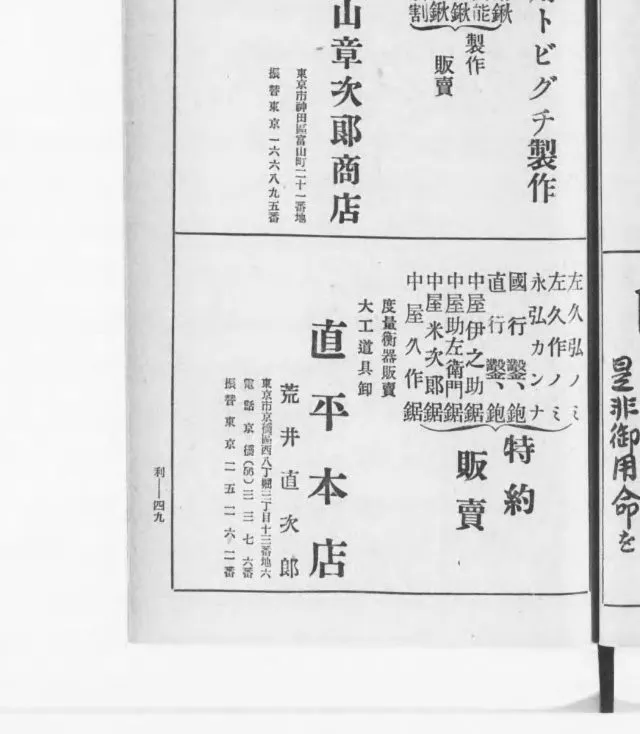
左久作左久弘左行弘國行
直平本店 Arai Naojirō 荒井直次郎
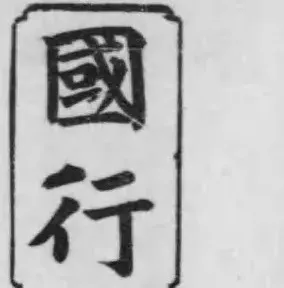
Carpentry-tool wholesaler. Its own mark 國行 was registered in 1902 (reg 17495), the house flagship. It also distributed (特約販賣) the Hidari-line chisels: 左久作 → Hidari-Hisasaku (Ikegami house), 左久弘 → the Kashiwagi Hidari-Hisahiro house, both register rows, with 左行弘. The linked forge 小泉鍛冶工場 (小泉佐右衞門, Sendagaya) is the maker. Beyond distributing, 荒井直次郎 was himself a groove-plane inventor, a run of registered plane designs 1906–1914 in his own name, the 荒井式三徳鉋 (reg 29900) and 荒井式両脇鉋 (reg 31808) among them (also reg 2848, 4008, 10654, 26442); reg 4008 independently confirms the 岡崎町2-17 address, recasting the house from pure trading office to a designing maker.[65]
京橋岡崎町2-17 → 西八丁堀3-13
1892
1124605·171 · 1027517·209
喜久弘義秀二代正光助重
湧井精一商店 Wakui Seiichi · from Niigata
Carpentry-tool maker/wholesaler. Sole Tokyo sales agent (發賣元) for Chiyozuru Korehide’s planes, a documented channel to the register’s greatest name.
神田紺屋町39 (工場 淺草大島町)
1909
1136112·250
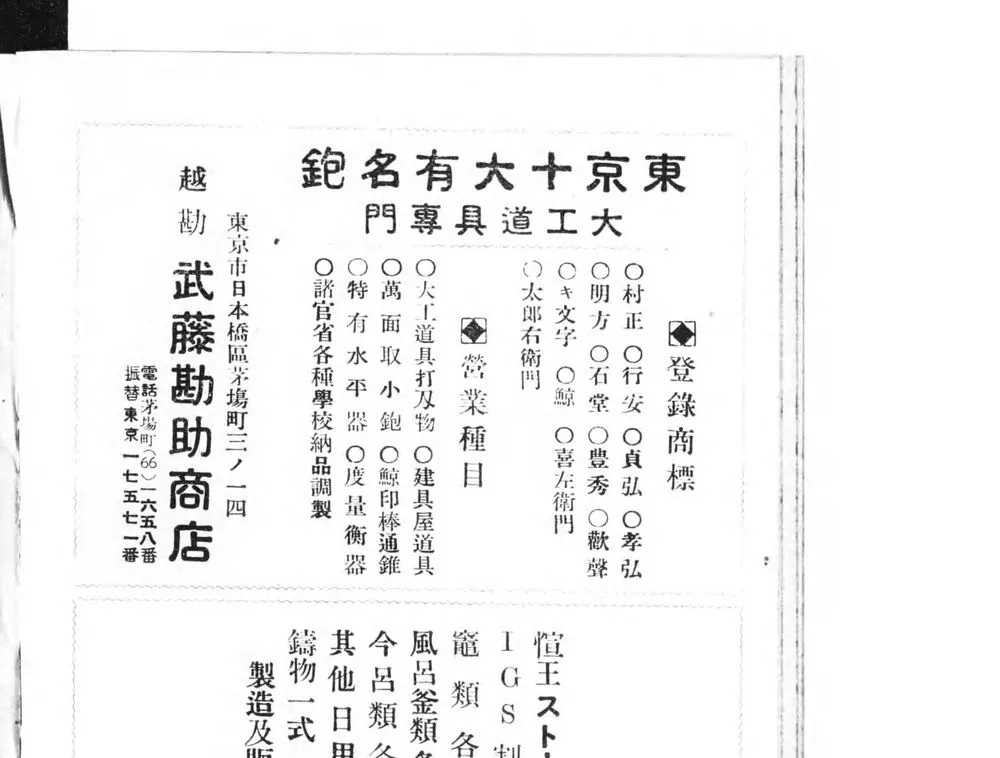
村正行安貞弘石堂豊秀國弘 …(12)
武藤勘助 / 越勘 Mutō Kansuke
“Tokyo’s Ten Famous Planes.” Each smith-name mark is a candidate register smith, 石堂 (Ishidō, a sword-lineage name), 國弘 (Kunihiro), 村正, 行安. Utility-model 越勘式萬年墨差 ink-liner; supplied government offices & schools. The house also registered two planes of its own design, 越勘式溝鉋 (reg 15093, 1909) and 武藤式溝鉋 (reg 31304, 1914).[65] In the trademark register reg 21200 (1904) is its 村正 mark[63]; a 1941 trade advertisement also shows a registered 鯨 (whale) mark for the house’s special-make goods.
北島町2-17 (1916) → 2-7 (1927) → 茅場町3-14 (1936–41)
1877
1029086·113 · 1027517·210
(steel & edge-tools)
湯浅屋 / 湯浅七左衛門 later 湯浅商店
Originally 炭屋七左衛門, a Kyoto charcoal merchant (from 1666) who opened an Edo shop in 1674 and joined the 江戸十組問屋 (the Edo ten associated wholesale guilds) as a 打物問屋 (forged-goods wholesaler).[81] By 1902 it was a Nihonbashi tool house selling plane cap-irons (合鉋裏金) and tobacco knives, the trade that supplied the new double-iron plane.[80] It appears among the hardware houses of the 1894 Tokyo business directory,[78] and is the ancestor of the modern Yuasa trading house.
Saw-maker (諸鋸製作) + carpentry-tool wholesaler; factory at Yaizu, Shizuoka; silver prize at the Nagoya exposition. 廣近 → a wholesaler mark of the Fujisaku forge (register §Fujisaku). Its trademark registration runs back to reg 14198 (1900).[63]
神田北乗物町11
1892
1136112·250
市弘千代弘響天勝弘源正圓
名取正勝商店 Natori Masakatsu · from Nagano
Chisel/plane/blade 発売元. 市弘 → Ichihiro (Yamazaki family, Nakano), the register records Natori claiming the 市弘 mark by 1941. In the Tokyo telephone directories 1926–41. The house was the 発売元 of its own proprietary planes, the 名取式 and 昭和式 合脇取鉋 (side-rabbet planes) carrying the maker’s name, with a factory at Senzoku-chō 2-131.
淺草千束町
1917
1022783·23
左宗弘重秀
荒井保雄 / 天満屋 from Tochigi
Identifies the register’s “Tenmaiya.” The provisional 左宗弘 (Hidari-Munehiro) row notes the smith “worked for the wholesaler Tenmaiya”; this is that house: 天満屋 = 荒井保雄, which registered 左宗弘. Carpentry-tool specialist; factory at Minami-shinagawa.
本所相生町4-17
1919
1136112·250
春光國信芳廣義久 + “TOKIO JAPAN” device
加藤伊助 / 木屋 (Kiya) Katō Isuke
The famous Nihonbashi Kiya cutlery house; forged-tool & whetstone wholesaler. Head of a 22-party Edo joint-trademark group (加藤伊助 外二十一名), a mark-pool in its own right; in the trademark register the house mark, a crossed-anchor / rising-sun “TOKIO JAPAN” device, is reg 24587, confirmed in the J-PlatPat gazette (出願 1905-07-20, 登録 1905-10-27), and Kiya was a leading edge-tool registrant. The house’s 寛政四年 (1792) founding is restated in its 1941 Kanamono Binran listing. A 1929 Nihonbashi gentleman’s directory records the firm as 合名會社木屋加藤伊助商店, sourcing from 播州 (Miki), Osaka and Sakai and importing steel from the USA and Germany, with sales reaching Korea, Manchuria and Taiwan.[63][64]
日本橋室町2-10
1792
1024841·92 · 1027517·209 · 1177677·238
丸今 (house) + 太陽/Brill, 浦島 (imports)
今津屋 Morioka Gentarō & Heiuemon
The 問屋 backer of the Meiji master chisel smith 清次 (Kashiwagi Seiji), the exclusive wholesaler–smith retainer system in action[43]. 森岡平右衞門 chaired the Tokyo Copper-&-Iron Wholesalers’ Guild; also a direct importer of edge tools. The house kept registering marks (a sailor-and-rifle device, reg 124921) as late as 1921 at the same Nihonbashi address, unbroken continuity; its 丸今 house-mark was registered as reg 21957 (1904). The edge-tool arm traded as 今津屋森岡商店 under 森岡廣吉 (1902, 打物・砥石卸小賣), passing to 森岡源太郎 by the 1920s, the forged-tool & whetstone side of the house, distinct from 森岡平右衞門’s copper-and-iron branch.[63]
日本橋本材木町1-28 → 本所荒井町 (1927)
Meiji
902305·359 · 803749·315
東國虎 (Kunitora)
鈴木寅吉商店 Suzuki Torakichi
Forged-tool & whetstone wholesaler; plane (鉋) 發賣元. Branch house 鈴木利平商店, Kanda Higashi-matsushita-chō 43.
神田松田町2
by 1917
950507·156
Founding dates, proprietor origins, and guild offices are read from the 1927 credit register (pid 1136112, koma 250) and cross-sources; the marks→smith links draw on the smith register above. Thirty-odd further houses are documented in the working master table.
Echikan / Mutō Kansuke Shōten, a carpentry-tool specialist founded 1877, Nihonbashi Kayabachō 3.
Reg. marks
村正行安貞弘孝弘明方石堂豊秀喜左衛門太郎右衛門 + 鯨印
Lines
Carpentry tools & forged blades · joinery tools · bevel-edge small planes · the 鯨印 bar-punch awl · a proprietary spirit level
Supplies
Government offices & schools, to order
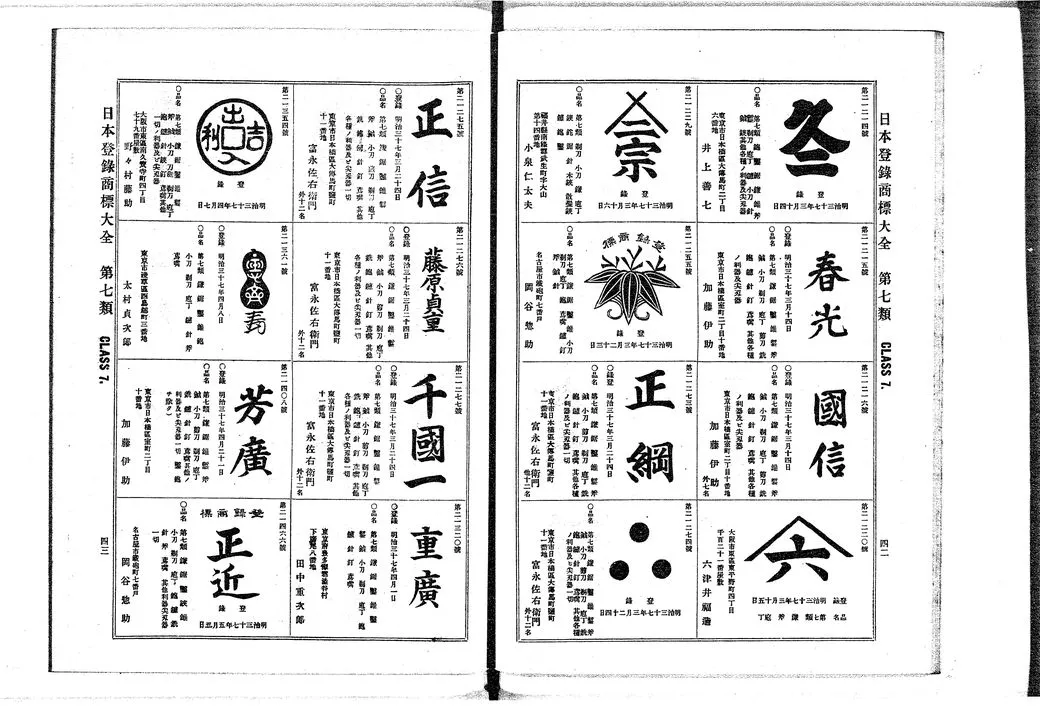
Registered edge-tool trademarks, Class 7, Nihon Tōroku Shōhyō Taizen, 1905. NDL pid 845522, koma 62.
Drawn marks, as registered
Chisel and plane trademarks reproduced exactly as filed, each a registered brand, and each a smith to recover. The visual companion to the wholesaler table above.
The Edo guild, 大工道具打物問屋 (1851)
Behind the Meiji wholesalers stood a chartered Edo guild. The 嘉永4 (1851) 諸問屋名前帳 registers the licensed 大工道具打物問屋, carpentry-tool and forged-goods wholesalers, as a recognized trade of seventeen houses across its main (本組) and provisional (仮組) rolls, most run for absentee Kyoto or Osaka owners through resident caretakers.[62] Two read as the roots of houses in the table above: 大坂屋佐右衛門 of Minami-Denma-chō, the yagō Tominaga still carried into the twentieth century, when 富永佐右衞門 chaired the wartime 東京利器工具工業組合 (edge-tool industrial guild); in 1904 the house registered a multi-owner mark consortium (富永佐右衞門 外十二名, reg 21273 ff., the 正綱 mark among them), a pool registering under the Ōsakaya umbrella[63], and 木屋 of Takara-chō, the house-name of Katō Isuke’s Kiya. The remainder: 炭屋七左衛門 (通油町), 奈良屋伊兵衛 (堀留町), 岡崎屋吉兵衛, 藍屋増太郎 (深川), and the 井坂屋 pair (忠兵衛 & 半兵衛), among others, a near-complete roster of the trade a full century before the Meiji directories.
Materials · the steel behind the blades
東郷鋼 (Tōgō Hagane) and the house of 河合佐兵衛
Every mark in this register was only ever as good as its steel, and for generations of Tokyo edge-tool smiths the prized bar was 東郷鋼 (Tōgō Hagane), a Swedish-origin tool steel sold by the Nihonbashi steel house 河合佐兵衛商店 (河合鋼商店) at 日本橋區本石町4-21. This is the supply side of the craft: not a smith, but the material a smith reached for.
The name. By the house’s own account, a previous head named the steel after Admiral Tōgō Heihachirō in the years after the Russo-Japanese War, to bind his product to the nation’s hero. He went to the admiral for permission, and Tōgō set a condition worthy of the trade: Japan had long had swords that could cut through a steel helmet; let a blade forged from this steel do the same. The house had a Kanda swordsmith, 正久 (Masahisa), forge two swords from its steel; Tōgō himself cut an old iron helmet with them, cleanly, and granted his name as a trademark. In May 1911 the house commissioned the sculptor 小倉右一郎 to cast a bronze statue of the admiral and set it at the shopfront.[66]
The house. The proprietor who carried the name through this register’s period was born the second son of 羽毛田金兵衛 on 23 September 1881 in Kanda Mikawa-chō (childhood name 忠吉); apprenticed to the previous 佐兵衛 at twelve, adopted as heir, and succeeded to the 佐兵衛 name. Between 1907 and 1910 the house registered some thirty trademarks for steel and semi-finished metals, filed in the same class as the great Sheffield firms[63], plus an edge-tool-class mark (reg 19135, an “S.K Steel” device, 1906). He sat on the Tokyo Chamber of Commerce (1921) and the Nihonbashi ward council, toured Europe to study steel (1926), ranked among Tokyo’s top taxpayers, and in 1930 received a Swedish royal decoration, a nod to the Swedish origin of the steel his house traded.[66] An earlier 河合佐兵衛 already appears in an 1890 Tokyo shoppers’ guide, trading steel as 井阪屋 (Isaka-ya), a Western-and-Japanese steel wholesaler in Nihonbashi (本銀町); very likely an earlier generation of the same house, its steel trade predating both the Kanda shopfront and the Tōgō brand.[68]
Why it belongs here. 東郷鋼 is the material behind many of the marks in this register: the steel a chisel or plane smith bought, forge-welded to soft iron, and quenched. Fittingly for a steel merchant, the house itself held finished-tool records too: a patent for a 鏨/探鑛鑿 (cold / prospecting chisel, reg 13982, 1909) and the 東郷ナイフ line, a steel house’s own products, not a bench smith’s hand.[65]
Case study · original documentation
The Fujisaku forge: one smith, five marks
Hasegawa Fujisaku (長谷川藤作, also read Tōsaku; b. Taishō 2 / 1913), of Komatsukawa, Edogawa-ku, trained under Yokosaka Santarō (横坂三太郎, mark Ichimonji 一文字) and was the senior brother-apprentice of Yamazaki Nobuji (光月, Fujisawa). Official factory registries document the Yokosaka forge: founded 1926 at Nishi-Komatsugawa 2428 with five to six workers (the only registered carpenter-chisel factory in the entire pre-1949 NDL text corpus), and a 1917 trade directory places Yokosaka in Yoita, Niigata before the move, giving the whole line Echigo-Yoita roots.[45] Hardware yearbooks list Fujisaku's shop annually 1968–1975 (mark 市国, Nishi-Komatsugawa 1-2806). A caution: at least two other prewar men shared the name 長谷川藤作 (a Kagawa tabi maker and a Shinagawa metal-spinner at Kami-Ōsaki), so a prewar record counts as the smith's only if it carries his Edogawa-ku address and 市国 mark. He belonged to the Tokyo Chisel Cooperative; Suzuki Kanamono's own history of that guild names him (as "Hasegawa of Komatsukawa", 小松川の長谷川氏) among its last seven members in the mid-1980s. He worked until about the start of Heisei, then moved to Saitama, where, as a PROSHOP HOKUTO dealer's blog recalls, he drove a taxi in retirement; the forge is closed. That same blog independently corroborates his training under Yokosaka and the brother-apprenticeship with 光月, and renders 弘正 in reverse as 正弘, the same mark, not a sixth.[1][2][45][5] His documented output spans five marks:
市國 / 左市國 his own mark 弘正廣近左茂弘 wholesaler marks 國秀 OEM for Morihei (森平, Asakusabashi), "for a while"[4]; Morihei held the 國秀 mark itself (株式会社森平, Asakusabashi 1-28-6; reg 4148125, 1998)[64]
Ironically he became best known by the wholesaler's name Hiromasa (弘正) rather than his own 市國.
The 左茂弘 (Hidari-Shigehiro) mark
The mark 左茂弘 itself appears in no formal written source: not the Suzuki genealogies, not Tenmoku's 33 documented Tokyo marks, not the auction archives, though its sibling wholesaler mark 廣近 now does (leg 4). Its attribution to the Fujisaku forge rests on four independent legs:
1. Attribution documented in dealer correspondence with Inoue Hamono-ten (井上刃物店), the century-old tool dealership in Sumida-ku, old Honjo smith territory, near the Komatsukawa forge, who identify 市國 as Hasegawa's own forge mark and 弘正/廣近/左茂弘 as the wholesaler marks.[20] 2. Japanese market knowledge: a Mercari listing states verbatim 「東京鑿で有名な長谷川藤作の左茂弘です。弘正、市国と同じ作者です」, "Hidari-Shigehiro by Hasegawa Fujisaku… same maker as Hiromasa and Ichikuni," tying the mark to the Tokyo chisel guild.[21] 3. A carpenter's blog listing 左茂弘 among the marks Fujisaku cut.[6]
4. The blades themselves carry the み stamp of the Tokyo Chisel Cooperative (東京鑿共同組合, 1947–1980s). Suzuki Kanamono's own history of that guild confirms the み is specifically the postwar cooperative's common trademark; the prewar 東京鑿同業組合 (1935–39) used a different mark (a blade 刃 in a circle, ○刃); and the same account independently attributes the sibling wholesaler mark 廣近 to "Hasegawa of Komatsukawa" and lists him among the guild's last seven members, so both the forge attribution and Fujisaku's membership are corroborated by the Suzuki corpus itself.[1] The stamp matches the み-marked 弘正/廣近/左茂弘 old stock still surfacing at auction, where a specialist seller identifies the み explicitly as the cooperative's certification mark.[21]
A boxed set of 左茂弘 thick chisels (厚鑿) in the author's collection, blades guild-stamped, box inscribed 東京製品・名匠・左茂弘作・厚鑿, may be the only fully documented example: certified blades paired with their presentation box. This is the same evidentiary class by which the Kunihide OEM fact survives: dealer testimony and physical marks, recorded before they are lost.
Which wholesaler issued 左茂弘? The trademark registry narrows it decisively: 左茂弘 was never registered, but a word mark 茂弘 was registered by 1953 (its owner recorded in the 文字商標集, vol. 2), and the sibling mark 廣近 was registered in 1931 (reg. 225629, class 8) to an owner at Kanda Kita-norimonochō 11, the address of Shimizu Kinsaku (清水金作), trade name Sendaiya (仙台屋), a Kanda cutlery/carpentry-tool wholesaler who registered blade trademarks continuously from 1900 to at least 1931. Directory evidence now fills in the house: founded 1892 (Meiji 25), Shimizu Kinsaku's Sendaiya was primarily a saw-maker (諸鋸製作) with a factory at Yaizu, Shizuoka, and took a silver prize at the Nagoya exposition. Sendaiya is the leading candidate for the house behind Fujisaku's wholesaler marks.[40][62]
A caution worth recording: a widely-seen AI search summary presents "Hiromasa" and "Ichikuni" as two separate smiths who "hand-scraped" their chisels. The two names are one man, and no source supports the hand-scraping claim, a reminder that every attribution here carries a citation for a reason.
The sword-smith aristocracy
The Chiyozuru & Ishidō file
Chiyozuru Korehide 千代鶴是秀 (1874–1957)
Born Katō Hiroshi (加藤廣) in Iikura, Tokyo, third son of the Yonezawa-domain swordsmith Chōunsai Tsunatoshi II; apprenticed at eleven to his uncle in the Ishidō house in Azabu, training alongside the same-aged future 9th-generation Hideichi; married the 8th generation's daughter Nobu at 21; used the name Chiyozuru from ~1892 and went independent in 1899.[22][50] The Taishō price ladder shows his standing: a carpenter earned ~1.5円 a day; an ordinary ten-chisel set cost 3.5円, Ishidō Hideichi's 75円, and a Chiyozuru set 100円.[50] From Taishō 9 (1920) he worked in Kami-Meguro in a chicken coop he converted with his own hands, the forge Kyūsanbō (九三房), named for its 9-shaku × 3-ken floor. The dealer Tsuchida Ichirō visited it two or three times a week for eighteen years and never saw another workshop so clean. The Takenaka museum physically rebuilt it for permanent display.[10]
「使われない道具」を鍛つようになったのには深い意味が含まれています。
His late works became "tools that are not used", functional perfection crossing into art. (Suzuki Kanamono essays[1])
The Edo-Kuma commission (1919): the Osaka-based master carpenter Katō Kumajirō (加藤熊次郎, "Edo-Kuma") begged Korehide for tools; refused (Korehide took no orders from strangers), he sent a letter with a copy of his family register attached. Korehide forged a set of oire-nomi priced at 150 yen when a carpenter's day wage was about 1.5 yen, and delivered it to Osaka himself by night train. At Kumajirō's death his Chiyozuru chisels numbered 37; brought back to Tokyo by his daughter (~1940), evacuated to Kamakura through the war under Tsuchida Ichirō's care, they reached the Takenaka museum around 1983. In 1942 Korehide forged a guardian short-sword for the family.[11][50] A 2019 study drawing on Kumajirō's grandson fills in the man behind the legend: born in Kamogawa, Chiba in 1873 and apprenticed in Tokyo's Fukagawa as a boy, he was a Kantō carpenter who only later moved to Osaka (the "Edo" of his nickname), and he died on 30 May 1942 of illness, not the self-starvation the popular retellings claim. That guardian short-sword, forged for his infant grandson Kan and signed by Korehide at sixty-six, entered the Takenaka museum in 2016, one of only two surviving swords known to be from Korehide's hand.[82]
The Ishidō house to the present day
Shogunal sword smiths for eight generations as Korekazu (是一); licensed to engrave the Tokugawa hollyhock crest. The 8th generation, 石堂助太郎, marks 是一 and 寿永, born a Katō (younger brother of Korehide's father Chōunsai Tsunatoshi II) and adopted into the Ishidō gate, turned the house to field- and then carpenter's-tool smithing from Meiji 3 (1870), ahead of the sword ban; by Hideo's own count the tool house ran "135 years, four generations, from Meiji 3." The line: Ishidō Korekazu (8th, d. 1891) →Ishidō Hideichi (9th, 1874–1931, Korehide's cousin, the "unsigned Ishidō," who generally cut no mark, though the plane mark 盛 (Sakari), coined from a carpenter's name, is attributed to his hand; identified by comb-form and arrow-feather ground patterns) → Ishidō Teruhide (10th, Kikuchi Seiichi, b. 1900 per a sword-trade bio, Suzuki's chronology implies ~1896–97; the postwar "phantom masterpiece" kanna; d. 1982, a month after silently authenticating an unsigned plane from his hospital bed) → Hideo (11th, b. 1932 Azabu, Teruhide's son by blood; formally succeeded 1971; moved the works from the 70-tsubo Ebisu shop to Oyama, Tochigi, where at 73 (in 2005) he still forged daily beside his son, Korehide's anvil in use; d. 2006 per collector/trade accounts) → Yoshitaka (12th, current, at the Oyama works, new Teruhide-brand kanna still retail ¥33–50k; under his full name 石堂良孝, he holds the 石堂輝秀 (Teruhide) trademark, reg 5515975 (2012), plus the house mark 飛雲[64]). The 5 June 1955 succession photograph survives in print: Teruhide, Korehide, Nobu, and Ochiai Uichi (as 延国, furigana のぶくに) all present.[60][5][12][50][61]
The Ishidō house & the Chiyozuru line, diagrammed
The sword-smith house of Ishidō and the Chiyozuru line it produced. Korehide trained in the Ishidō house alongside the 9th generation and married the 8th generation's daughter (dashed link). His four early pupils all came to grief; the succession ran instead through Ochiai and, by honorific bestowal, not apprenticeship, the Miki Sadahide line, which continues today. After the Suzuki, Takenaka and Tsuchida sources of the Chiyozuru & Ishidō file.
Joint work and a second provenance. A documented 1952 plane, 師恩 (Shion), was forged by Teruhide and hardened by Korehide, a rare collaboration of the two houses, and re-issued in 2002 by Ishidō Hideo as a Korehide memorial. And beyond Tsuchida, a second first-hand channel survives: the Shibuya dealer Yoshizawa Rikō (吉沢利工, est. 1910), whose founder Yoshizawa Kenzō dealt with Korehide in person and which holds named Korehide works, the planes 嶺月 and 鴻山春, a kiridashi 象魚, and a rare 藤四郎-signed chisel.[57][58]
Korehide's son Chiyozuru Tarō (加藤太郎, b. Meiji 40 / 1907) forged planes under the hereditary Ishidō art-name Unju (運壽) from ~1930, registered by the wholesaler Wakui Seiichi. Torn between smithing and his sculpture studies at the Tama Fine Arts School, he vanished into the crater of Mount Mihara on Izu Ōshima in January Shōwa 8 (1933), aged 25 (27 by traditional count; the Suzuki site's "28" is its own small error), weeks before the notorious Mihara suicide wave of that year.[35] He forged Unju planes for only a few years before his death; afterward Korehide himself continued the Unju mark as a memorial. The mark was then also ghost-forged by "Suzuki of Ōizumi," briefly by Nobukuni (the later Chiyozuru III), and a "Kanayama of Toyama", either Kanayama Tsugutomi (金山盡富, d. 1960, whose Unju carries a 千 stamp) or Kanayama Tetsuo (金山鉄夫, documented for the variant 源運壽), with Korehide personally hardening and finishing all but Nobukuni's; the Suzuki hantei study names further Unju forgers 山口由太郎 (Yamaguchi Yūtarō, own mark 兼晴, 山口鉋製作所, Adachi Okino-chō) and 尾島功大 (also Adachi) and, last of all, 田中昭吾 (Yoita), several shops across Tokyo and Yoita under one wholesaler's mark. A Takenaka study of the plane-smith 神田規久夫 (Kanda Kikuo, whose own mark is も作) adds him to this succession, giving the postwar order as 鈴木 to 落合 to 金山 to 神田 to 尾島.[77] Identifying who forged which Unju plane is a research problem the Suzuki essays address directly.[1][35]
Korehide's four pupils all came to grief: Tsuyukubo Sadakichi (mark Sadahide, died young of tuberculosis), Katsujirō (quit), Sakakibara Miyoji (died as a student), Nishio Eikichi (Korehide's nephew, his sister Jun's son; mark Hidefusa, independent 1917, mental collapse), after which he took no pupils from Taishō 7 (1918) on.[35] Succession ran instead through Ochiai Uichi (落合宇一, taught personally from 1925, formally 3rd-gen Chiyozuru from 8 January 1948, the succession witnessed by Yoshizawa Kenzō and Wakui of Kanda, who also signed 三水 and 無我; d. ~1973–74 per Tsuchida)[57] and the Miki Sadahide (貞秀) line, Kanki Yoshirō (神吉義良, 1908–1999), a Miki plane smith of the 國弘 line who, since Korehide took no formal pupils, called on him as an admirer and in 1949 was honorifically granted the mark 貞秀, the name Korehide had first given his own late pupil Tsuyukubo Sadakichi. It passed to Yoshirō's son Kanki Iwao (神吉岩雄, b. 1944; 2代目 from 1990) and then to a pupil, Morita Naoki (森田直樹, b. 1978; 3代目 from 2019), continuing today. Museum and dealer accounts loosely call this an apprenticeship; the Suzuki genealogy is explicit it was a bestowal, not a lineage. (The family's own site counts Korehide himself as the first generation, shifting its numbering by one.)[35][26] In 1955 Korehide's wife Nobu, the 8th-gen Ishidō's daughter, divorced him to adopt Teruhide's son Hideo and restore the Ishidō family register as its 11th generation, then remarried him.[35]
The trade behind the tools
How Tokyo's toolmaking was organised, 1852 to 1947
A Tokyo chisel never came from a lone smith at an anvil. Behind every 鑿 (nomi, chisel) and 鉋 (kanna, plane) stood a dense trade: the wholesalers who financed and sold it, the steel houses who imported or rolled its cutting steel, the quarry families who cut its whetstone, and the guilds that bound them into a single order. This is the world the smiths in this register worked inside, from its Edo roots to its wartime dissolution.
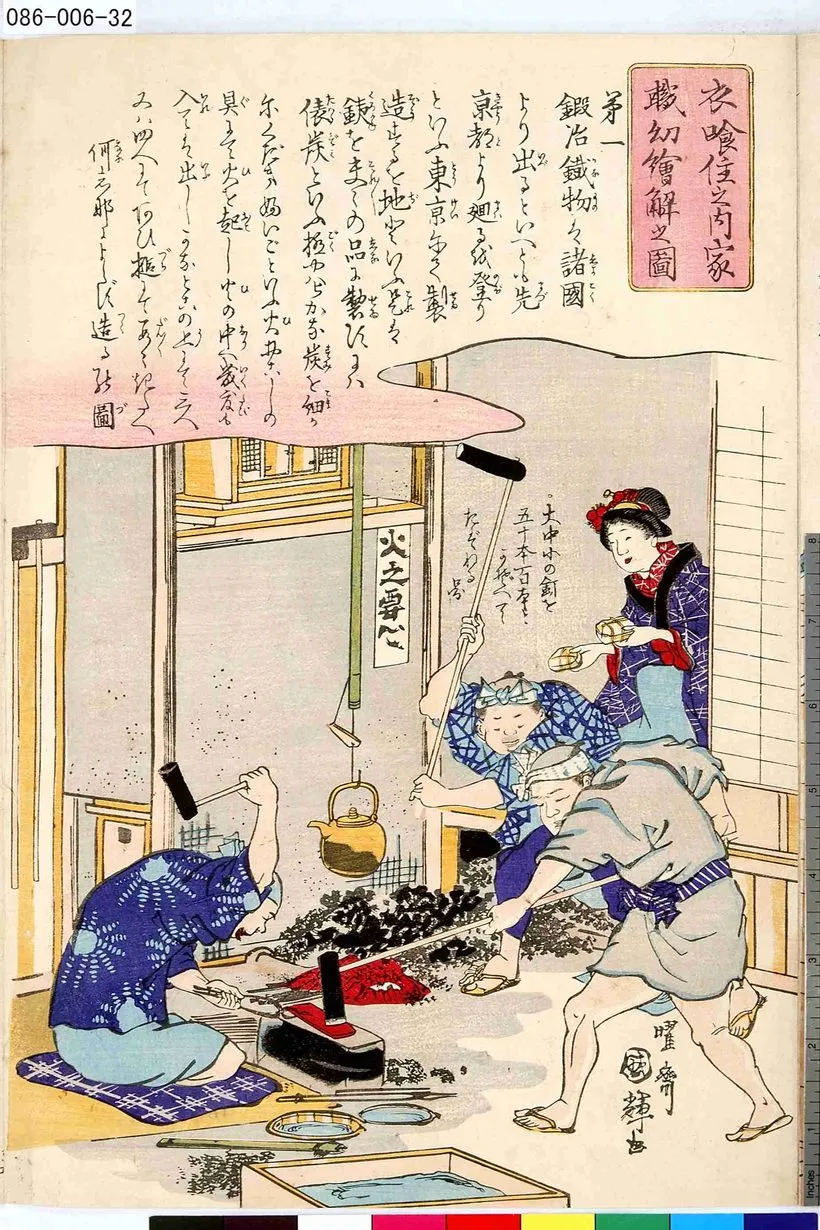
衣喰住之内家職幼絵解之図「鍛冶鉄物」 · the blacksmith-and-hardware plate from an illustrated Edo guide to the trades, made to teach children how each craft worked: the smith at the anvil, around whom the whole web of wholesalers, steel houses and guilds was built.[72]
Edo roots: the ten-guild wholesalers and the Kawai clan
Tokyo's tool trade began as an Edo wholesalers' trade. Carpentry tools and forged hardware moved through the 十組問屋 (tokumi-doiya, the ten associated wholesale guilds), and one house in this register's own orbit sat inside it: 井坂屋忠兵衛 (Isaka-ya Chūbei), a carpentry-tool and forged-goods wholesaler (大工道具打物問屋) who joined the guild in 1852 and paid a fifty-ryō levy in 1854.[62]
That house was the head shop of a single merchant family, the 河合 (Kawai), all trading under the shop-name 井坂屋 (Isaka-ya), whose branches run through this register for the next century. By an 1889 commercial roster the family had split into three trades:[62]河合忠兵衛, the Asakusa head shop (井坂屋本店), a carpentry-tool house founded 1829 and by the 1920s a fourth-generation firm that registered four edge-tool trademarks for planes and chisels (鉋鑿) in June 1899, selling under its own brand;[63]河合佐兵衛, the Nihonbashi steel house that became the 東郷鋼 brand (above); and 河合半兵衛, an iron and steel-bar house. One family thus links this register's steel house, a carpentry-tool brand, and the Edo hardware guild in a single line.
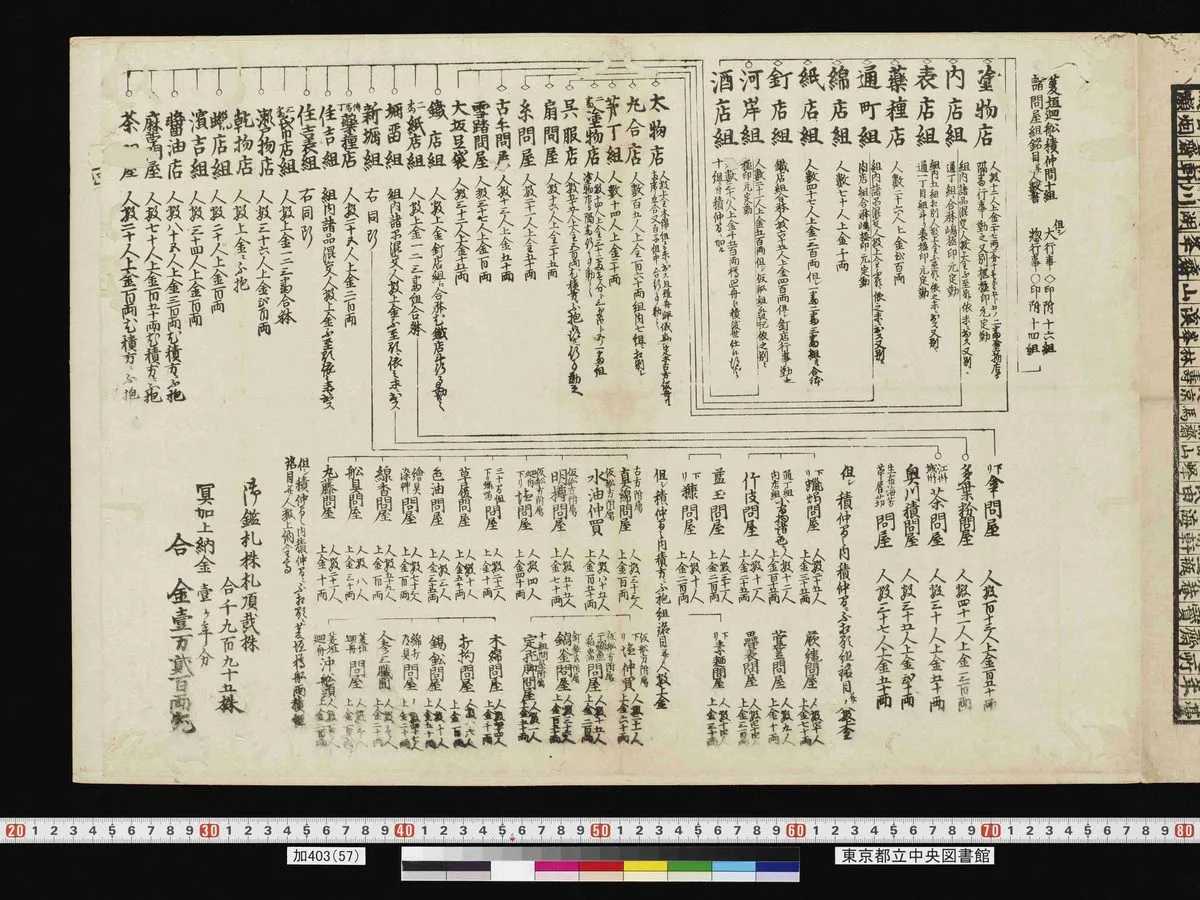
菱垣廻舩積仲間十組 諸問屋組銘目并人数書 · the register of the ten-group wholesaler guilds (十組問屋), their names, membership and levies, including the 鐵店組 (iron) and 釘店組 (nail and hardware) groups that are the direct antecedents of the Tokyo tool trade.[72]
The Meiji hardware guilds
As Edo became Tokyo, the wholesalers re-organised under Meiji commercial law. The 東京金物問屋組合 (Tokyo Hardware Wholesalers' Guild) was founded on 14 October 1887, chaired by 秋田直吉 (Akita Naokichi), a Kayabachō metal-goods wholesaler who also sat on the Chamber of Commerce.[67][69] The central body came in the new century: the 東京金物同業組合 (Tokyo Hardware Trade Guild) was licensed on 4 November 1915, its office first at Nihonbashi Kodenma-kamichō 10 and, from the later 1920s, at Kanda Higashi-Kon'yachō 49. Its first head was 大久保鑑左衞門 (Ōkubo Kanzaemon); by 1930 the chair was 吉川百太夫 (Yoshikawa Momodayū).[67][69] By the mid-1930s it was large, with roughly 650 affiliated shops and some 15,000 employees, split into divisions (部): an edge-tool division (利器部), a building-hardware division, and a cast-iron wholesale division.[69]
The edge-tool trade organises itself
This is the heart of the story for a tool register. There was no separate carpenter's-tool guild; the carpenter's-tool dealers sat inside the association's edge-tool division (利器部), about sixty shops in a 1931 survey and sixty-seven to sixty-eight by the 1934 roster, of which only a dozen or so were principally carpenter's-tool shops.[69] At the end of the 1930s the edge-tool trade spun out into two guilds of its own, both housed in the same building at Kanda Higashi-Kon'yachō 21, and both headed by houses in this register.
The makers' guild. The 東京利器工具工業組合 (Tokyo Edge-Tool and Tool Makers' Guild), founded 1 July 1938 with about twenty-two members, was headed by 富永佐右衞門 (Tominaga Sa'emon) of the 大佐 (Ōsa) house.[69] The wholesalers' guild. The 東京利器工具卸商業組合 (Tokyo Edge-Tool Wholesalers' Guild), the old edge-tool division made standalone, founded 4 July 1939 with sixty-one members, was headed by 加藤伊助 (Katō Isuke) of 木屋 (Kiya).[69]
So by 1939 the two halves of Tokyo's edge-tool trade, the makers and the wholesalers, were each led by a house this register tracks, working under one roof. (The neighbouring 東京工具製造工業組合, at the same address, is the machine-tool makers' guild, taps and dies and gauges, a different trade.)
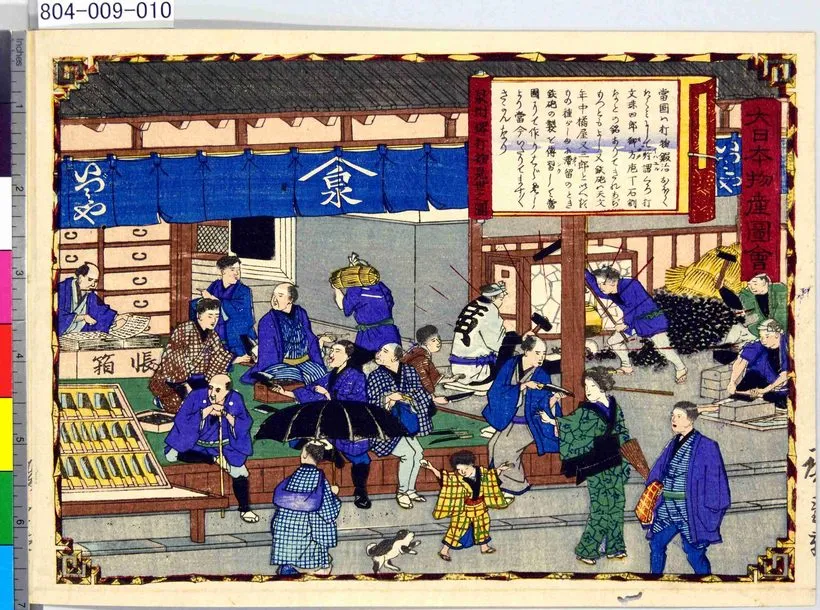
泉州堺打物見世之圖 · a forged-blade (打物) shopfront in Sakai, blades laid out for sale, from 大日本物産圖會 (Hiroshige III): the retail end of the edge-tool trade that the Tokyo houses grew out of.[72]
The national tier and the war
Above Tokyo sat a national structure. The Osaka and Tokyo hardware guilds jointly founded the 日本金物同業組合聯合會 (Japan Hardware Guild Federation), registered 22 October 1917, which from December 1917 ran a uniform export-inspection regime under ministry ordinance.[69] The war absorbed all of it: a 日本利器工匠具統制協會 (Japan Edge-Tool Control Association) was established on 29 July 1943 by direction of the Ministry of Commerce and Industry, headquartered in Kanda with ten regional branches (Sanjō, Seki, Miki and Kōchi among them), to assess and control edge-tool prices; the trade was decontrolled again in 1947.[69]
The supply chain: steel and whetstones
The register's smiths forged imported and, later, domestic tool steel, and the houses that supplied it overlap the register itself. The 東京銅鐵問屋組合 (Copper-Iron Wholesalers' Guild), founded 12 May 1886, was chaired by 河合佐兵衛 of the 東郷 house from 1926, with 森岡平右衞門 of 今津屋 also an officer: two more register houses inside the steel-supply guild.[67][69] Domestic tatara-descended 安来鋼 (Yasuki steel) from Shimane reached the Tokyo tool trade through authorised dealers such as 松永虎平商店 (established 1924), a Hitachi/Yasuki-steel agent and supplier to the Railway Ministry and the services.[62][70]
Before those domestic steels, Tokyo's tool smiths worked imported crucible steel. The Sheffield "Eagle" steel of Seebohm & Dickstahl reached Japan from 1889 under an eagle-on-globe mark (later sold as Arthur Balfour); Austrian W6 and W4 (Böhler and Schoeller-Bleckmann) and Swedish ASSAB followed. The bench testing behind these choices survives in the museum's blade-steel survey, whose samples were supplied by the register's own 左久作 (the Ikegami house).[73]
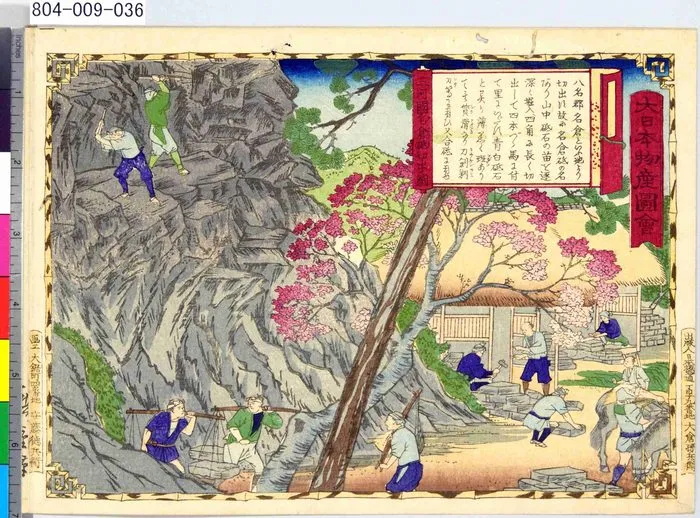
三河國名倉砥切出ノ圖 · cutting the Mikawa Nagura whetstone at the quarry, from 大日本物産圖會 (Hiroshige III).[72]
The register's houses are repeatedly styled 打物・砥石商 (forged tools and whetstones), and the whetstone side was a formal trade too: the 東京打物砥石問屋組合 (Forged-tool and Whetstone Wholesalers' Guild) appears in the prefectural statistics of 1886 to 1898, headed, once again, by 加藤伊助 (Kiya).[70] Behind the stone stood a quarry dynasty: the 三河名倉砥 (Mikawa Nagura whetstone), the bedding stone every plane and chisel needs, was cut by the 戸村 (Tomura) family, who worked the quarry for six generations (1712 to 1872) and were named shogunal purveyors (御用砥) in 1862. A telling detail for a carpenter's register: the quarry graded its output, and the lower grades were the woodworkers' stones.[70]
A finished plane needed a third trade beside the smith and the wholesaler: the 台屋 (dai-ya), who fitted the blade into its wooden block. In Tokyo these block-makers had their own body, the 東京鉋台製造組合 (Tokyo Plane-block Manufacturing Guild), documented from the Meiji 30s, and at least one multi-generation house, the 布川 (Fukawa) of Kamata and Hatchōbori, of Niigata origin, whose head served as the guild's accountant and chairman around 1934. The trade ran as a chain: a wholesaler owning registered marks had a smith strike the blade and back-iron under those marks, took them to a block-maker to be fitted, and sold the finished plane.[75]
A roll-call of 1877
The First National Industrial Exhibition (第一回内国勧業博覧会, Ueno, 1877) required each exhibitor to file trade, address and method, and the surviving records are the fullest early roster of Tokyo edge-tool smiths. Among the carpentry-tool makers they name, several with founding dates reaching into the Edo period: the axe-smith 田中九兵衛 (from Kan'ei 5 / 1628), the file-smith 田中定次郎 (Genroku 3 / 1690), the adze-smith 樋口善太郎 (Genroku 10 / 1697), the Shimo-Shibuya chisel-smith 田中繁次郎 (working the "二挺取り" two-at-a-time method), the Shitaya saw-smith 矢木勘治郎, and clusters of Edo file-smiths and plane-makers. It is the documentary floor beneath much of this register's Meiji coverage.[79]
The inventions: the "shiki" planes as patents
Several marks in this register are not smiths' names but product types (式, shiki), and these are registered utility models (実用新案, minor patents), catalogued by the Patent Office. They date the inventions and name the holders:[65] the 荒井式 planes (reg 29900 and 31808, held by 荒井直次郎, about 1913 to 1914); the 越勘式 and 武藤式 groove-planes, one man, 武藤勘助 (reg 15093 about 1909 and 31304 about 1914); the three 堤式 planes (reg 7838, 7839 and 7840, about 1905 to 1910); and 戸張式機械作里 (reg 28194, about 1913), held by 碓氷奥助 (Usui Okusuke), who is this register's own 助國 (Sukekuni) smith, so "Tobari" is a design-name, not a separate house. The 堤 registrations even drew a challenge from a rival, 松島芳次郎; the appeal was dismissed in April 1911.[65]
Where sources disagree on a date, this register shows both rather than choosing. The 内山源次郎 house is dated 1916 in its own register entry but 創業明治10年 (1877) in a 1927 credit directory.[62] The 越勘 house (武藤勘助) is founded 1877 in one directory and 1878 (明治11) in another.[62][69] The 大佐 house (富永) reads as a Kaei-era (1848 to 1854) house in the 1904 credit registers, which separately date its 大佐商店 shopfront to 1899.[62] And 河合佐兵衛's birth is given as 1881 in one business who's-who[66] and as about 1869 in another.[70]
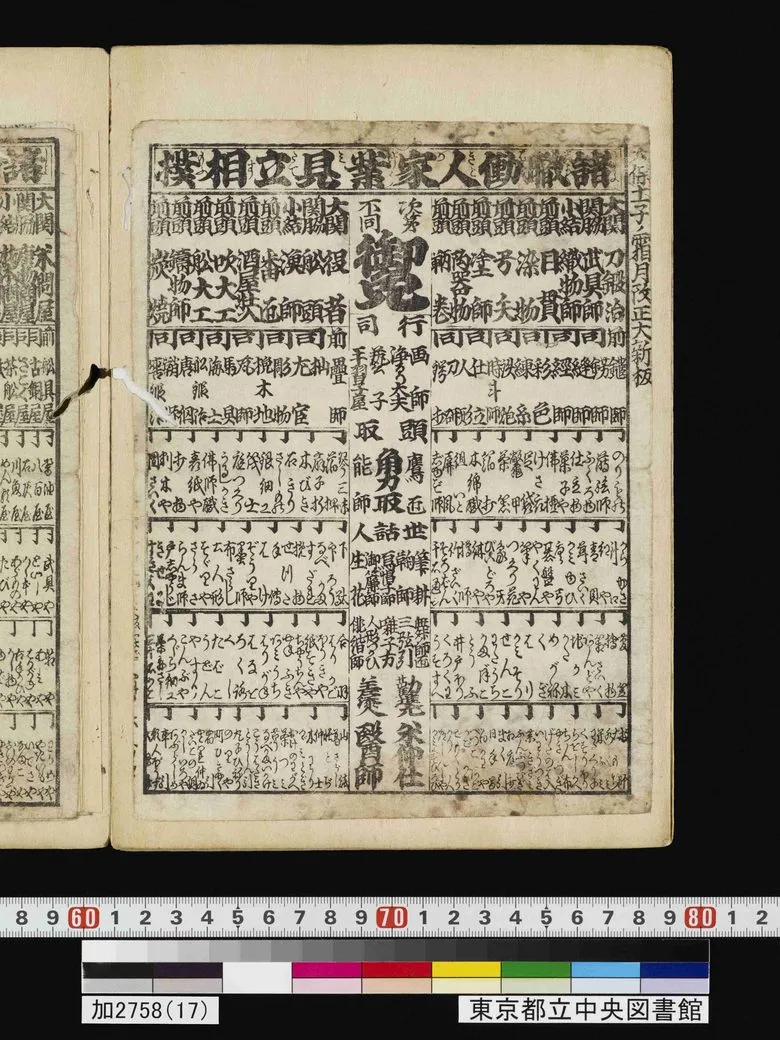
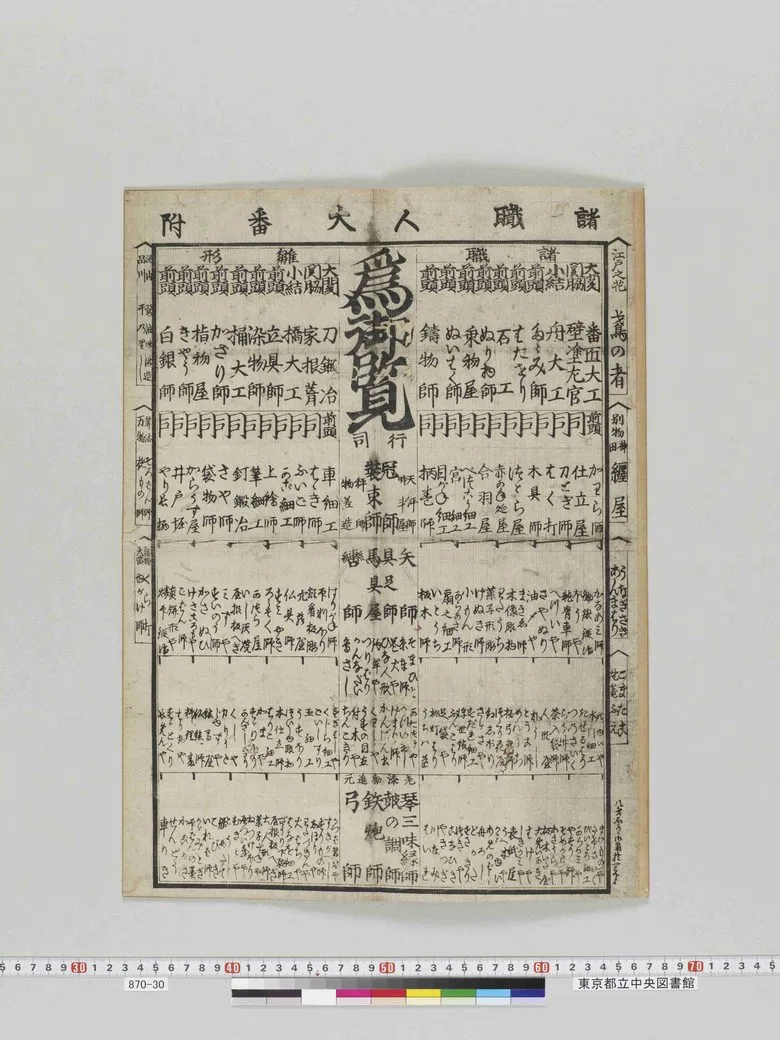
諸職人家業見立相撲 · craftsmen ranked as a mock sumo match, Tenpō 11 (1840)[72]諸職人大番附 · the grand ranking of all the craftsmen's trades[72]
Institutions
Guilds, wars, and the shape of the trade
1603
Kanda Kajichō (神田鍛冶町) created in Edo's first town-planning, around the residence of Takai Iori, the shogunate's chief smith for the eight Kantō provinces.[27]
1699 →
Guild evolution: voluntary inner guilds → shogunal kimoiri registration → licensed kabunakama → Meiji trade associations (同業組合), the legal ancestors of the chisel guilds.[28]
1871–76
Sword-abolition edicts push sword smiths into tools, the origin story of the Ishidō conversion and of 東京打刃物.[29]
1879
Tōkyō Meikō Kagami (東京名工鑑) records early-Meiji Tokyo master craftsmen, including the earliest named saw and file (yasuri) smiths, though notably no chisel or plane smiths. Fully digitized, public domain.[13]
~1830s?
Origin legend recorded 1904: the Tempō-era swordsmith Katsumoto (勝元), who came to Edo in the Aizu lord's retinue, is named the founding father (元祖) of Edo chisel-making, tying the Tokyo trade's origin story to Aizu.[43]
1892
Tsukishima created as Tokyo Bay reclamation lot No. 1; cheap land beside the Ishikawajima shipyard breeds a metalworking quarter, the ecology that later hosts Kiyotada and Hidari-Hisasaku.[30]
1904–05
The trade journal 東洋銅鉄雑誌 runs a serialized set of profiles of old-Edo master smiths, one per issue: seal-knife, beef-knife, kitchen-knife (東源正久), plane (田中義廣), chisel (柏木清次), saw (中屋久作 XVI), and thin-blade (正則). This is the earliest journalistic record of the trade.[43]
1915
The 東京金物同業組合 (Tokyo Hardware Trade Guild) is founded on 4 November 1915, its office at 神田區東紺屋町49 (Kanda, Higashi-Kon'yachō); by 1929 it counts 77 member houses under heads 吉川百太夫 & 澤田梅吉, its jurisdiction all of Tokyo, while the older wholesalers' guild, the 東京金物問屋組合, already dates back to 1887.[67]
1923–30
The Great Kantō Earthquake scatters the central shitamachi smiths outward along the Nikkō-kaidō corridor (Kanda → Shitaya → Minowa → Senju) to cheap, quake-spared land still one streetcar from the wholesalers, the true origin of the "Senju" chisel cluster. Ichihiro re-founds in Nakano (1924); Yokosaka founds Komatsukawa (1926); Masayoshi I sets up in Mikawashima (1930).[46]
~1935
Tokyo Chisel Trade Association (東京鑿同業組合), first guild mark era.[1]
1941–42
The 金物便覧 volumes map Tokyo's ~18 edge-tool wholesale houses (木屋 est. 1792; 武藤勘助 1877; 直平 1892; 湧井精一 1909; 内山源次郎 1916; 名取正勝 with its 市弘 trademark grid), and the 1942 official price schedule formally classes 「東京府産」 chisels as their own premium category.[39]
1944
Wartime control association for edge tools (利器工匠具統制組合) ordered, and the independent trade is swallowed; the 東京金物同業組合 (est. 1915) dissolves, publishing its own history on the way out.[31][47]
1947
Tokyo Chisel Cooperative (東京鑿共同組合) re-formed by Ikegami Kisaku with 18 surviving forges (17+ lost to the war); Kisaku its first postwar chairman, second guild mark era; Fujisaku a member. Membership: 13 forges by 1953; seven by the mid-1980s under chairman Yamazaki Isamu (Ichihiro II), the six other named survivors being Hidari-Hisasaku, Shimamura (清忠), Suzuki of Kokubunji, Tanaka (長弘), Hasegawa of Komatsukawa, and Fujikura of Kokubunji, after which the cooperative faded out (自然消滅) rather than formally dissolving. A successor body carried the guild function on until about 2006, when Kiyotada II noted first-hand that "the nomi guild existed until just the other day"; its formal name is not yet recovered; candidates include the nominally-surviving 全国鑿製造連合会 (est. June 1966 at Yahiko-Iwamuro; "in name only" by 1992 per the Hisasaku memoir) and a 東京刃物組合 attested in 1979. (The memoir styles the 1947 revival 東京鑿同業組合, the old name, while Suzuki, after consulting the author, records the formal name as 東京鑿共同組合; the memoir counts six forges remaining by 1985.)[1][2][61]
東京打刃物 designated a Tokyo Metropolitan traditional craft (areas: Adachi, Arakawa, Taitō), today mostly knives and shears; carpentry-tool forging survives at the Katsushika 宗秋 (Yaegashi) forge among a dwindling few.[29][19]
2006–14
The end of the classical generation: Ichihiro III dies and the Kiyotada forge closes and is demolished (2006); Ikegami Takanobu, Hidari-Hisasaku II, dies 21 Aug 2008 aged 84; Kiyotada II dies 2011; Masayoshi II (Yuzawa Akio) dies 2014.[36][38][48]
Why Senju? Answered
The "Senju cluster" turns out to be a 20th-century phenomenon, not an Edo one. Tokyo's tool smiths historically sat in the central shitamachi (Kanda Kajichō → Shitaya/Asakusa → Minowa); the 1923 earthquake and the reconstruction plan pushed small workshops outward along the historic Nikkō-kaidō exit corridor to cheap, unregulated, quake-spared land; Adachi's own ward history records the post-quake influx. Senju supplied the label because it was already the commercial capital of the northeast: largest of the four Edo post-towns (est. 1625), seat of the yacchaba produce market from ~1720, a five-highway junction, and a rail hub from 1896, with blacksmiths documented among its trades since at least 1823, and (the kernel of truth in the lumber theory) an unusual concentration of timber dealers thanks to river transport. Masayoshi I is the type case: independent in Mikawashima in 1930, famous as "Masayoshi of Senju" by reputation and retail.[46]
Corrections
Common misattributions
Names frequently sold or cited as "Tokyo" that are not, and related traps:
田斎 (Tasai), Sanjō, Niigata (Tasai Akio b. 1939; son Michio is a licensed swordsmith). No Tokyo lineage.[32] · 清久 (Kiyohisa), Watanabe family, Sanjō; the Tokyo flavor comes from auction listings grouping him with Kiyotada.[5] · 大内 (Ōuchi), Miki, Hyōgo, founded 1890.[33] · 元寿舟弘 (Funahiro), Yoita, Niigata, not Tokyo: Funatsu Yūji (船津祐司), third-generation 舟弘刃物製作所, a certified Traditional Craftsman (伝統工芸士), awarded the Order of the Sacred Treasure (瑞宝単光章) in 2016 (d. 13 March 2026, aged 81); brands 五台山 / 天慶 / 元寿; his blades use 新和鋼 (Shinwa steel, said to rival tamahagane).[56][58] · Modern 國弘 planes, an unrelated Sanjō brand; do not conflate with the Edo lineage.[5] · "Hiromasa of Sanjō", eBay boilerplate; the forge was Edogawa-ku, Tokyo.[4] · 助國 chisels on the market, mostly not by Usui Okusuke.[7] · 千代鶴是秀 fakes, abundant; auction average ~¥73k but attribution risk is severe; dealer-guaranteed pieces reach ¥1.1M, and the faking is not only modern: Suzuki documents 小熊寅三郎 of Yoita striking unauthorized 㐂運壽/運壽 marks with a deceptive 是秀 stamp.[34][1] · "Masayoshi b. 1891" (English dealer page), contradicted by the primary source: 加藤由之助 was born 1908.[37] · "Kiyotada" as one smith, two generations; the guild-founder and Chiyozuru-replica episodes may belong to different generations in different tellings.[36] · 助國 vs 國秀 vs 秀國, three distinct marks; don't conflate.[42] · 東住人 stamps, some Echigo (Yoita) smiths stamped 東住人 ("resident of the East") to pass work off as Tokyo-made; treat it as a caution, not a Tokyo credential.[58] · The 「左」 prefix (左久弘, 左市弘, 左清忠, 左久作…), not a sign of left-handedness, nor of a failing business (左前), but the mark a Tokyo smith added on going independent as a custom order-smith (誂え鍛冶), per the Suzuki genealogy and the Hidari-Hisasaku forge's own account.[2][53]
The living thread
Living forges, shops, and collections
Yaegashi Uchihamono (八重樫打刃物製作所, Tateishi, Katsushika), a 江戸打刃物 house descended from a Nanbu swordsmith (the 宗秋 name); in Tokyo from 1912, Tateishi from 1928; still forges knives, chisels, and planes by sword technique under 4th-gen Yaegashi Junichi.[19] · Hidari-Hisasaku (左久作, Tsukishima), a surviving Edo custom (誂え) forge; status unverified since 2017, visit soon.[17] · Masayoshi Daiku-dōgu-ten (Senju), Yuzawa Akio, Masayoshi II.[6] · Inoue Hamono-ten (Sumida-ku), century-old dealer holding Korehide pieces; a living archive of east-Tokyo attribution knowledge.[20] · Tsuchida Hamono-ten (Sangenjaya), Tsuchida Noboru, third generation, the leading Chiyozuru scholar.[3] · Morihei (森平, Asakusabashi), whetstone house whose Kunihide brand Fujisaku once forged.[4] · Takenaka Carpentry Tools Museum (Kobe), ~35,000 tools, the rebuilt Kyūsanbō forge, the Edo-Kuma chisels.[10]
The translated corpus
The Suzuki Kanamono essays
The tool-history corpus of Suzuki Toshiaki (鈴木俊昭) of Suzuki Kanamono[1], roughly 46 essay series, has been translated into English for this project, most of it for the first time. The translations are not published here: they are renderings of Suzuki-san's own copyrighted essays, and will go online only with his permission. What this register carries is the factual substance drawn from them, cited throughout. As a sense of the ground those essays cover, beyond Tokyo:
Aizu, eastern Japan's tool capital, seeded from Kyoto/Fushimi smiths brought by Gamō Ujisato (~1591); the Shigefusa (重房) school whose "Shige-" prefix marks the whole region; the last Aizu saw smith Nakaya Denzaemon III, still forging. · Miki, Miyano Tetsunosuke II (tamahagane saws) and the chisel master Kinryū (錦龍, Nishiki Masao, 1924–1980), whose sets sold at five to ten times ordinary prices. · Sanjō, the Eikō/Hatsuhiro plane genealogies whose steel choices are credited as the impetus for Hitachi's Aogami and Shirogami; the Yoshiei/Kaihiro chisel lines. · Tool history, the two-blade plane's emergence re-dated; the Edo-me saw-tooth question; the nationwide maebiki-saw survey (a first, per the author); sumitsubo, trowel, whetstone, kanejaku, and Buddhist-sculpture-chisel histories; the Shōwa-7 (1932) plane-price catalog read against carpenter wages; and the author's historiography of tool research itself.
The Japanese originals and the English translations are held privately, preserved against the day these Shift-JIS-era pages go offline, and the translations are available on request. They will be posted here only if Suzuki-san grants permission.
A primary source, in facsimile
The two Tokyo saw-smiths of 1879
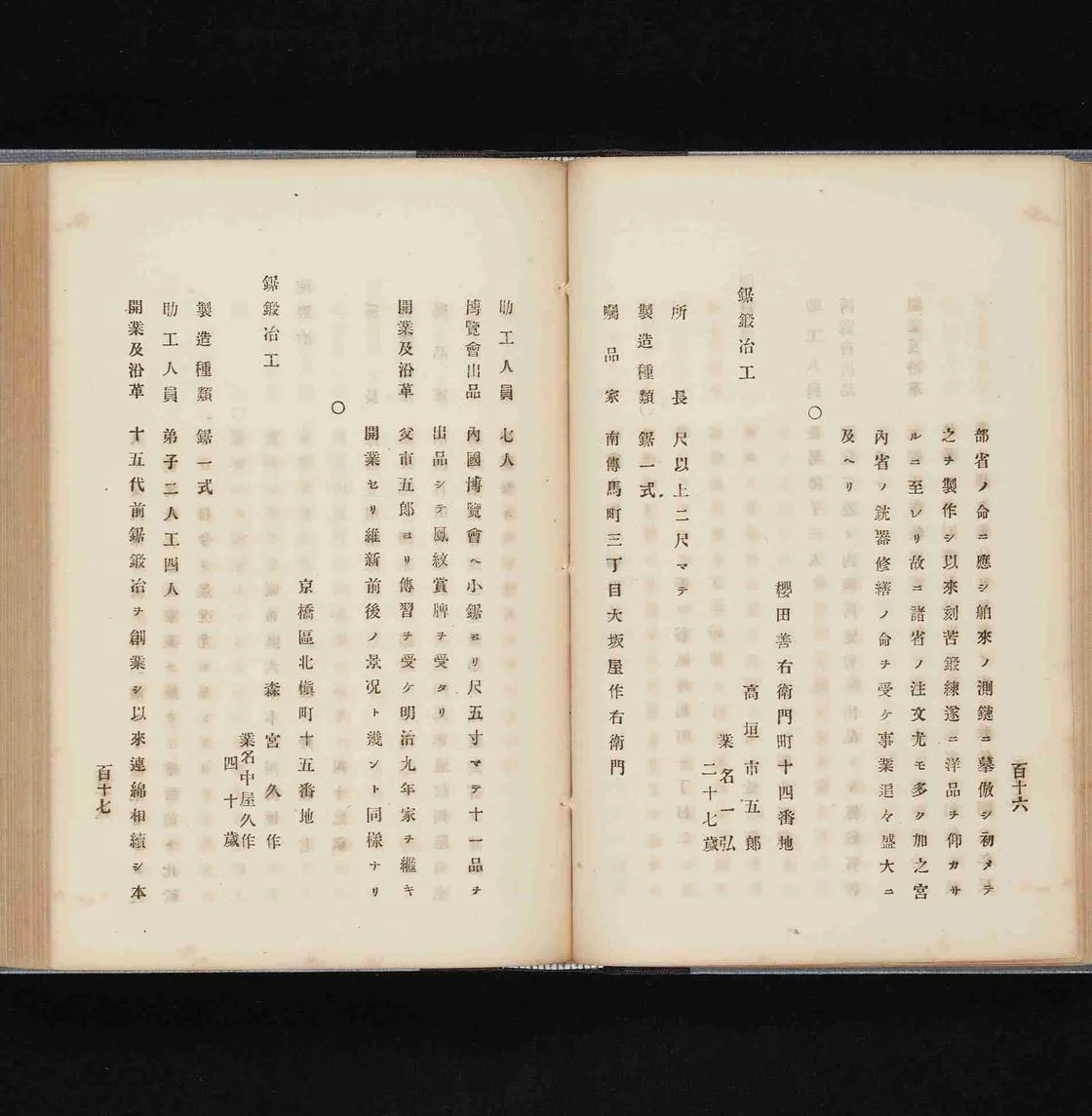
Unlike the working translations above, renderings of copyrighted modern essays, this is a public-domain primary source, reproduced in full. The 1879 Tōkyō Meikō Kagami, vol. 坤 (Kon), records early-Meiji Tokyo’s master craftsmen by trade. Its 鍛冶 (smith) section is dominated by gunsmiths turning to machinery; it even includes the inventor Tanaka Hisashige (田中久重, whose firm became Toshiba), but on facing leaves 116–117 it preserves the city’s two saw-smiths (鋸鍛冶). No chisel or plane smiths appear; in 1879 those names were not yet famous. That makes this the earliest first-hand record of Tokyo edge-tool blacksmithing, here in English for the first time.
東京名工鑑 坤 (1879), leaves 116–117, the two 鋸鍛冶工 (saw-smith) entries, read top-to-bottom, right-to-left. Facsimile courtesy of the Tokyo Metropolitan Central Library digital archive (public domain).
高垣市五郎 · Takagaki Ichigorō
Saw-smith (鋸鍛冶工) · mark 一弘 Ichihiro · age 27
Shop
Sakurada Zen’emon-chō no. 14.
Patron
Ōsakaya Sakuemon (大坂屋作右衛門), the wholesale house that commissioned his work, at Minami-Denma-chō 3-chōme, the same 大坂屋 yagō and street the 1851 guild roll enters as 大坂屋佐右衛門 and that survived into the twentieth century as the wholesaler 富永佐右衞門, tying this 1879 saw-smith’s patron to the register’s Tominaga line.
Work
A full range of saws, from over 1 shaku (~30 cm) up to 2 shaku (~60 cm).
Workshop
Seven assistants.
Exhibition
Showed eleven saws, from small saws up to 1 shaku 5 sun (~45 cm), at the First National Industrial Exhibition (1877), and won the Phoenix-crest medal (鳳紋賞牌).
History
Learned the craft from his father Ichigorō, succeeded to the house, and opened for business in Meiji 9 (1876); trade was little changed from around the Restoration.
中屋久作 · Nakaya Kyūsaku
Saw-smith (鋸鍛冶工) · trade name (family name Mori, 森) · age 40
Shop
Kyōbashi, Kita-Makichō no. 15.
Work
A full range of saws.
Workshop
Two apprentices and four workmen.
History
The house founded its saw-smithing fifteen generations earlier and has carried it on unbroken down to the present head.
Identified
A 2009 Takenaka monograph names the house the 森宮 (Morimiya) family and this fifteenth head 森宮久作 (b. 1839), known as 中橋の久作 (Kyūsaku of Nakabashi); the Kita-Makichō shop stood where the Yaesu Building by Tokyo Station now is, and his mark was the 笹葉 (bamboo-leaf). Dated Nakaya saws survive, the oldest collected at Leiden in 1817 to 1828; a Kyūsaku saw passed 中屋久作 → Ogawa Hakuzan → 千代鶴是秀 (Korehide) → the dealer Tsuchida.[76]
Source: 東京名工鑑 坤 (Tōkyō Meikō Kagami, vol. Kon), Tokyo Prefectural Industrial Promotion Section, 1879, leaves 116–117, 「鋸鍛冶工」. Public domain; digitized by the Tokyo Metropolitan Central Library (call no. RT0.750/3012/G2). Translation by this project; Takagaki’s mark 一弘 and these details corroborate the Suzuki Kanamono account.[13]
Citations
Sources
Japanese titles are kept as cited, with an English rendering of each source name on the line beneath (in blue). Access notes: many older Japanese sites are Shift-JIS encoded and may render garbled in automatic translators, open them in a browser with encoding detection.
Primary corpus (translated for this edition)
Suzuki Kanamono (スズキ金物店), Dōgu no Rekishi essay series, Tokyo chisel genealogies, guild histories, Chiyozuru studies. misyuku-suzuki-kanamonoten.comSuzuki Hardware Store; the "History of Tools" (Dōgu no Rekishi) essay series.
Tsuchida Noboru 土田昇, 刃物たるべく――職人の昭和 (Misuzu Shobō, 2020), chapters on Kiyotada (嶋村幸三郎) and Ishidō Teruhide; also 職人の近代 (2017), 瀏瀏と研ぐ (2024). msz.co.jpTitles: "To Be a Blade, A Craftsman's Shōwa"; also "A Craftsman's Modern Age" (2017) and "Sharpening Clear and Limpid" (2024).
Tenmoku, "Other Tokyo Chisel Marks", marks #23–25 (弘正/市國/廣近) and the Morihei Kunihide account. tenmoku0701.myshopify.com
PROSHOPHOKUTO dealer pages (Shift-JIS): 東京鉋 sub56, 追入鑿 sub11, 石堂輝秀 sub18, late-Shōwa Tokyo trade attributions.Page labels: "Tokyo planes" (sub56), "oire bench mortise-chisels" (sub11), and the smith Ishidō Teruhide (sub18).
千葉の大工日記 (carpenter's blog), Fujisaku marks incl. 左茂弘; Masayoshi shop visit reports. yuisaepapa.exblog.jp; 建築工房日記 ameblo.jp/k-dai9Blogs: "A Chiba Carpenter's Diary" and "Building Workshop Diary."
Tenmoku, Tokyo chisel marks #26–33, Sukekuni (碓氷奥助), Hidari-Munehiro, Hidari-Hisakiyo. Same URL as [4].
Takenaka Carpentry Tools Museum bulletin (all free PDFs, J-STAGE)
竹中大工道具館研究紀要 vols. 1–37 (1989–2026), open access. jstage.jst.go.jp/browse/dougukanTakenaka Carpentry Tools Museum Research Bulletin.
Ishisha Shūichi 石社修一, 「現代鍛冶技法の保存調査報告 その1 ― 鉋鍛冶[も作]銘 神田規久夫の記録」, vol. 24 (2013). doi.org/10.50862/dougukan.24.0_3"Report on the Preservation Survey of Modern Smithing Techniques, Part 1, a record of plane-smith Kanda Kikuo (the 'Mosaku' mark)."
Nishiyama Marcelo 西山マルセーロ, 「千代鶴是秀の鍛冶場「九三房」再現事業について」, vol. 27 (2016). J-STAGE; Kobecco column 九三房の世界"On the Project to Reconstruct Chiyozuru Korehide's Forge 'Kyūsanbō'"; the column "The World of Kyūsanbō."
Sakamoto Tadanori 坂本忠規, 「大工「江戸熊」こと加藤熊次郎と守り刀」, vol. 30 (2019). J-STAGE; Kobecco 江戸熊の鑿"The Carpenter 'Edo-Kuma', Katō Kumajirō and His Guardian Blade"; the column "Edo-Kuma's Chisels."
文化遺産オンライン, 鉋刃「神雲夢」(千代鶴是秀) and 鉋刃 (石堂秀一, "the unsigned Ishidō"). detail/112127, detail/134818"Cultural Heritage Online" (national database), the plane blade "Shin'unmu" (Korehide) and an unsigned Ishidō plane blade.
National Diet Library Digital Collections
東京名工鑑 (Tōkyō Meikō Kagami, 1879), a two-volume Tokyo-government register of master craftsmen by trade; public domain. Vol. 乾 (乾之巻, decorative crafts) at NDL pid 900133; vol. 坤 (坤之巻, metal trades, including the two 鋸鍛冶 saw-smiths 高垣市五郎 and 中屋久作, leaves 116–117) digitized by the Tokyo Metropolitan Central Library TOKYO Archive (call no. RT0.750/3012/G2)."A Mirror of Tokyo Master Craftsmen" (1879), 2 vols, vol. 乾 decorative crafts, vol. 坤 metal trades (the saw-smiths).
住と建築 nos. 425–427, 440, 454 (1996–98), Ichihiro III (Yamazaki Shōzō) interview series. dl.ndl.go.jp/pid/7976701 (NDL login/partner library)"Housing and Architecture," a home-and-building journal.
Kanisawa Hirotake 蟹澤宏剛, 「鑿鍛冶 市弘製作所[東京・中野区]」, 建築雑誌 no. 1542 (2006). aij.or.jp"Chisel-Smith: the Ichihiro Works [Nakano, Tokyo]," in the Journal of Architecture and Building Science (AIJ), no. 1542.
National Diet Library, Meiji–Shōwa trade directories (2026 mining)
NDL 次世代デジタルライブラリー, public-domain hardware / wholesaler trade directories and credit registers mined August 2026, cited in the wholesaler register by pid·koma: 金物便覧 (1941/42, pid 1022783 / 1124605), 帝国商工信用録 (1927, pid 1136112), 日満金属業者名鑑 (1937, pid 1029086), 東洋金属名鑑 (1917/27, pid 950507 / 1105740), 大日本商工録 (1940, pid 1030128), 帝国商工録・東京 (1932, pid 1024841), 職業別電話名簿 (1926–34), and 大日本金属同業一覧 (1912, pid 932888), plus the Edo guild registers 諸問屋名前帳 / 仮組名前帳 (1851, pid 2548773 / 2572022). lab.ndl.go.jp/dlFull-text-searchable public-domain trade directories, National Diet Library.
NDL, 日本登録商標大全 (Complete Register of Japanese Trademarks), the Meiji–Taishō edge-tool classes (第七類 / 第八類), pid 902305–941565, the registered marks, owners, dates, and numbers behind the wholesaler attributions.The official registered-trademark compendia.
J-PlatPat (特許情報プラットフォーム, Japan Patent Office), the 商標公報 trademark gazette: registrant, address, application & registration dates, and registration number. It retains the Meiji–Taishō edge-tool registrations (e.g. Kiya reg 24587, 出願/登録 1905; 川口惣吉 reg 32237, 登録 1908) as well as postwar marks, a primary-source check on the NDL compendia (gazette PDFs pulled Aug 2026). j-platpat.inpit.go.jpThe Japan Patent Office trademark database.
NDL, the digitized Japanese patent & utility-model registers (特許証主府県別表 1907 pid 796645; 実用新案登録証主名簿 1908 pid 845454; 実用新案分類表 1908 pid 902270; 実用新案分類総目録 1912 pid 845455; 特許発明分類総目録 1914 pid 1913957; 専売特許発明全書 1894 pid 845485): inventor names, ward addresses, registration numbers and dates for Tokyo carpentry-tool patents and utility models (2026 mining).The patent & utility-model registers.
NDL, 現代業界人物集 (Contemporary Business-World Figures), 1935, pid 1036963, koma 89–90, the 河合佐兵衛 / 東郷鋼 (Tōgō Hagane) house biography: the Admiral-Tōgō naming, the Kanda swordsmith 正久 helmet-cutting test, the 1911 statue, and the proprietor’s dates and honours.A 1935 who’s-who of industry.
NDL, 東京市産業関係団体便覧 (Tokyo City Directory of Industry-Related Organizations), 昭和5年/1930 (pid 1466086) and 昭和7年/1932 (pid 1466088), koma 12–13, the 東京金物同業組合’s own directory record: founded 4 Nov 1915, office 神田區東紺屋町49, scope 金物器具製造販賣, 77 member houses in 1929 (70 by 1932) under heads 吉川百太夫 / 澤田梅吉 (later 橋本太吉 / 平澤傳一). Also dates the 東京金物問屋組合 to 1887 and the 東京機械金物商同業組合 to 1919.A city directory of trade associations.
NDL, 東京買物独案内 (商人名家; A Shoppers’ Guide to Tokyo), 明治23年/1890, pid 803720, koma 69/111, an earlier-generation 河合佐兵衛 (with a 河合半兵衛) trading steel as 井阪屋 in Nihonbashi, before the Kanda / Tōgō-steel era.An 1890 Tokyo merchant guide.
NDL, the Tokyo guild-organisation directories and rosters (2026 mining): 東京市商業・工業・貿易組合一覧 (昭和14年/1940, pid 1124846), 工業組合名簿 (昭和13年/1938, pid 1116130), 重要物産同業組合一覧 (大正6年, pid 936600), 日本職業大系 商業篇 (1934, pid 1448648), 北海道金物商業組合聯合会 沿革史 (1944, pid 1107190), and 大阪市産業叢書 (1935, pid 1173777): the foundings, offices, heads, member counts and division structure of the Tokyo hardware and edge-tool guilds, and the national federation and wartime control association.Directories of trade and industrial guilds, National Diet Library.
NDL, the steel and whetstone supply-trade records (2026 mining): the 三河名倉砥 (Mikawa Nagura) whetstone-quarry biography of the 戸村 family (pid 1705146, koma 26-39), the 安来鋼 (Yasuki-steel) Tokyo dealer listings, and the Tokyo prefectural statistics naming the 東京打物砥石問屋組合 (forged-tool and whetstone wholesalers' guild); with the 河合佐兵衛 "already seventy in 1939" who's-who entry.Sources on the steel and whetstone trades that supplied the tool smiths.
村松貞次郎 道具曼陀羅 (毎日新聞社, 1978), the architectural historian's classic survey of Japanese hand tools and the smiths who made them.Muramatsu Teijirō, "Dōgu Mandara" (Tool Mandala), a 1978 study of hand tools.
Tokyo Metropolitan Library Digital Archive (東京都立中央図書館 デジタルアーカイブ), the Edo and Meiji woodblock plates of the trades: 大日本物産圖會 (Dai-Nihon Bussan Zue, Utagawa Hiroshige III, 1877) for the Sakai forged-blade shop (item 00233852) and the Mikawa Nagura whetstone quarry (00233878); 衣喰住之内家職幼絵解之図, an illustrated children's guide to the trades, for the blacksmith-and-hardware plate (00009404); 菱垣廻舩積仲間十組 諸問屋組銘目并人数書, the ten-group wholesaler register (00042147); and the craftsmen ranking-sheets 諸職人家業見立相撲 (Tenpō 11 / 1840) and 諸職人大番附. Public domain.Woodblock prints of the Edo and Meiji trades, Tokyo Metropolitan Library.
沖本弘, 刃物の鋼・地金に関する調査 (Blade steel and jigane), 竹中大工道具館研究紀要 vol. 2, J-Stage (open access): the survey of imported crucible tool-steels (Sheffield "Eagle" of Seebohm & Dickstahl, Austrian Böhler W6/W4, Swedish ASSAB), its ten samples supplied by the 左久作 (Ikegami) smith.Takenaka Carpentry Tools Museum Research Bulletin, on blade steel.
沖本弘, 鉋刃の熱処理組織について (Heat-treatment microstructure of plane blades), 竹中大工道具館研究紀要 vol. 3, J-Stage: hardness and mark records of 義廣 and 千代鶴運壽 planes, and the blue-paper-steel (青紙1号) origin story.Takenaka Bulletin, on plane-blade metallurgy.
星野欣也・土屋安見・石村具美, 鉋台製造に関する歴史と現状 (History and present state of plane-block making), 竹中大工道具館研究紀要 vol. 5, J-Stage: the 台屋 (dai-ya) block-maker trade, the 東京鉋台製造組合 (Tokyo Plane-block Manufacturing Guild), and the 布川 (Fukawa) house.Takenaka Bulletin, on the plane-block trade.
星野欣也・船曵悦子, 鋸鍛冶「中屋久作」について (On the saw-smith Nakaya Kyūsaku), 竹中大工道具館研究紀要 vol. 20 (2009), J-Stage: the 森宮 (Morimiya) family behind the 中屋久作 business name, the 15th-generation 森宮久作 (b. 1839), the 笹葉 (bamboo-leaf) mark, and a dated catalogue of Nakaya saws.Takenaka Bulletin, the Nakaya Kyūsaku saw-smith monograph.
石社修一, 現代鍛冶技法の保存調査報告 その1 「も作」銘 神田規久夫の記録 (A record of Kanda Kikuo, mark Mosaku), 竹中大工道具館研究紀要 vol. 24 (2013), J-Stage: the biography and marks of the plane-smith 神田規久夫 (も作), his place in the 運壽 (Unju) succession, and the 義廣 / 國弘 Edo trade-lineage.Takenaka Bulletin, the Mosaku / Kanda Kikuo record.
星野欣也・坂本忠規, 明治27年『東京諸営業員録』にみる金物・利器工匠具業 (The hardware and edge-tool trades in the 1894 Tokyo business directory), 竹中大工道具館研究紀要 vol. 36 (2025), J-Stage: an addressed roster of Meiji-Tokyo hardware, hardware-manufacturing and cellar-carpenter houses, including 湯浅.Takenaka Bulletin, on the 1894 Tokyo trade directory.
星野欣也・坂本忠規, 第一回内国勧業博覧会 出品物にみる利器工匠具 (Edge tools among the exhibits of the 1877 First National Industrial Exhibition), 竹中大工道具館研究紀要 vol. 37 (2026), J-Stage: a dated, addressed roster of Edo and Tokyo edge-tool smiths, several with Edo-period founding dates.Takenaka Bulletin, on the 1877 exhibition roster.
船曵悦子, 近現代における鉋の変遷 (Historical Changes of the Plane in the Modern Era), 日本建築学会技術報告集 17(37), 2011: the datable history of the double-iron (chipbreaker) plane, the tobacco-knife origin of cap-irons, and the Nihonbashi tool wholesaler 湯浅商店 (1902).A 2011 architectural-technology study of the plane's evolution.
桑田優, 近世後期における三木金物と大坂・江戸市場 (Late-Edo Miki hardware and the Osaka and Edo markets), 社会経済史学 (1979): the 炭屋七左衛門 (later 湯浅) house joining the Edo ten-guild as a forged-goods wholesaler, and the 1824 Edo forged-goods-wholesaler roster.A socio-economic history of the Edo edge-tool market.
坂本忠規, 大工「江戸熊」こと加藤熊次郎と守り刀 (The carpenter "Edo-Kuma" Katō Kumajirō and his guardian sword), 竹中大工道具館研究紀要 vol. 30 (2019), J-Stage: a family-sourced biography of 加藤熊次郎 (Edo-Kuma) that corrects the popular legend, and a study of the 1942 Korehide-forged guardian short-sword now in the museum.Takenaka Bulletin, on the carpenter Edo-Kuma and his Korehide sword.
佃島・月島百景 oral-history videos, the flux-recipe story. tsukishima100.com; Ikegami Takanobu, 江戸鍛冶の注文帳, CiNii BN11989749"One Hundred Views of Tsukudajima and Tsukishima"; Ikegami Takanobu, "An Edo Blacksmith's Order Book."
Wards, government, and living forges
八重樫打刃物製作所 official site muneaki.net; Katsushika certified-craftsmen list city.katsushika.lg.jpYaegashi Forged-Blade Works, official site.
井上刃物店 (Inoue Hamono-ten, Sumida-ku), the mark attribution rests on direct correspondence with the shop (2026), in which they identify 市國 as Hasegawa Fujisaku's own forge mark and 弘正/廣近/左茂弘 as wholesaler marks. In further correspondence (2026, published with permission) the shop explains the origin of the 左 (Hidari) prefix: a Niigata wholesaler had registered the smiths' own marks (市国, 市弘 and others) as trademarks without permission and demanded a royalty on every blade sold, so the smiths registered fresh 左-prefixed marks they could use freely; it also confirms the readings 東一正芳 (Tōichi Masayoshi), 市弘 (Ichihiro) and 孝弘 (Takahiro). Shop directory e-shops.jp; visit essays acroge-furniture.comInoue Blade Shop (Inoue Hamono-ten), Sumida.
Mercari listing 叩き鑿 1.2寸 東京鑿組合 左茂弘, seller attribution text. jp.mercari.com/item/m78233123676; Yahoo Auctions seller karakigennou, み-stamped 弘正/廣近/左茂弘 old stock with the note 「「み」は東京鑿共同組合の印です」, e.g. f1239059922 (左茂弘), d521764571 (廣近) (listings expire; text archived)A "struck (tataki) chisel, 1.2 sun, Tokyo Chisel Guild," Hidari-Shigehiro mark; the seller's note reads "the 'mi' stamp is the mark of the Tokyo Chisel Cooperative."
Chiyozuru biography & market
朝日新聞 Marion column, 千代鶴是秀の道具 (2020). asahi-mullion.com; 古美術ささき artist page kobijutsu.ne.jp; Shirasaki Hideo, 千代鶴是秀 (Kōdansha, 1978), NDL pid 12424759 (onsite)Asahi Shimbun, "The Tools of Chiyozuru Korehide"; the antique dealer Kobijutsu Sasaki; Shirasaki Hideo, "Chiyozuru Korehide" (biography).
開運!なんでも鑑定団 (TV Tokyo, 2018-09-11), the 1941 Korehide kanna appraisal. tv-tokyo.co.jp"Kaiun! Nandemo Kanteidan", the "What's It Worth?" TV appraisal show.
Context: geography, guilds, wartime
Kawashima Kazuhito 河島一仁, 「日本における鋳物師・鍛冶に関する研究の進展」, 立命館文學 627, the 11 blade districts; Kanda Kajichō casters. ritsumei.ac.jp (PDF)"Advances in Research on Casters and Smiths in Japan," Ritsumeikan Bungaku (literary review) no. 627.
大工道具の曼陀羅屋, 大工道具鍛冶紀行, "Tōkyō dōgu" and the fire-rebuild-demand thesis. daiku-dougu.jp (Shift-JIS)"Mandara-ya of Carpentry Tools" (dealer), the "Carpentry-Tool Smith Travelogue."
千代鶴貞秀 official lineage page. chiyozurusadahide.jpChiyozuru Sadahide (smith), official lineage page.
千代田区 town-name plaques, 鍛冶町/神田鍛冶町. city.chiyoda.lg.jpChiyoda Ward, the town names Kajichō ("Smiths' Town") and Kanda-Kajichō.
東京建設業協会, 江戸の職人発展史 (2003). token.or.jp (Shift-JIS)Tokyo Construction Contractors Association, "A History of the Rise of Edo Craftsmen" (2003).
東京都産業労働局, 東京打刃物 designation page. dento-tokyo.metro.tokyo.lg.jpTokyo Metropolitan Bureau of Industry and Labor, the "Tokyo Uchi-hamono (forged blades)" designation.
古美術ささき dealer listing (guaranteed 1946 延壽 kanna, ¥1.1M) kobijutsu.ne.jp; aucfan closed-price aggregates for 是秀/石堂輝秀/千代鶴.The antique dealer Kobijutsu Sasaki; closed-price aggregates for the smiths Korehide, Ishidō Teruhide, and Chiyozuru.
Suzuki Kanamono, 千代鶴の系譜 series (intro + sections 2–11, 2006), Tarō's fate, Korehide's pupils, the Ishidō register restoration. tiyodurukorehide.html (translated for this research, not published).The "Chiyozuru Lineage" (Chiyozuru no Keifu) series.
Kurashige Tools (YAMASUKE), "Interesting stories about Tokyo blacksmiths" + mark charts, Kiyotada two-generation biography, Ichihiro chronology, mark taxonomies, ~20 smith identities. Kiyotada, Ichihiro, Kiyotada marks; Suiheiya brand ownership per Covington & Sons
Suzuki Kanamono, 鑿鍛冶名人 series (translated for this edition), Masayoshi I b. Meiji 41 (1908), independent Mikawashima 1930; Cornish Little Nomi Shop Masayoshi set page (hand-work account; its "b. 1891" is contradicted by the primary source)The "Master Chisel-Smiths" (Nomi-kaji Meijin) series.
金物便覧 (工業日日新聞社, 1941/1942), Tokyo wholesaler directory, 名取正勝商店 trademark grid (incl. 市弘), 1942 official price schedule with the 東京府産 premium class. NDL, free: pid 1022783, pid 1027517, pid 1124605"Hardware Handbook" (Kōgyō Nichinichi Shimbun-sha), the Natori Masakatsu shop's trademark grid; the "made-in-Tokyo-Prefecture" premium class.
J-PlatPat / JPO trademark registry (swept 2026-08-16): 左市弘 reg. 390598 (1949, family-held, Nakano); 左久作 regs. 389384/1339314; 清忠 reg. 405555 (1951, Taitō); the 1951 application-publication 昭26-12058 gives the owner as 高橋銀平 of Asakusa Senzoku-chō, superseding an earlier index read of 高橋渉; 國秀 reg. 4148125 (1997, 株式会社森平); 小信 reg. 814862 (Takiguchi family); 廣近 reg. 225629 (1931, Kanda Kita-norimonochō 11 = Sendaiya/清水金作). Registry: j-platpat.inpit.go.jp; stable per-registration pages via search.toreru.jp
明日への扉 #164 「江戸打刃物職人 小沼亮介」 (2023), documentary on the Yaegashi/宗秋 workshop. episode page, YouTube"Doorway to Tomorrow" #164, "Edo Forged-Blade Craftsman Konuma Ryōsuke" (2023).
HITNET 産業技術史資料共通データベース, open mirror of the Takenaka collection catalog (225 chisels, 234 planes, with marks/dates/photos), incl. the 久弘/左久弘 gourd-frame cluster and dated Korehide/Tarō/Teruhide pieces. sts.kahaku.go.jpHITNET, the "Common Database of Historical Materials on Industrial Technology."
東洋銅鉄雑誌 (1904–09, 64 issues, NDL pids 1574026–1574089), serialized profiles of old-Edo master smiths; the chisel installment (1(4), 1904-11) profiles 柏木清次/清廣 and names the Tempō swordsmith 勝元 (came with the Aizu lord) as founder of Edo chisel-making; wholesaler backer 今津屋=森岡源太郎. NDL 送信サービス; snippets free. pid 1574029"The Oriental Copper & Iron Magazine" (1904–09), the wholesaler-backer Imazuya = Morioka Gentarō.
井上一平, 日本商標の研究 (実業之日本社, 1957), chisel smiths as wholesalers' exclusive retainers, with named pairings (岡谷→清長, 今津屋(森岡)→…). NDL pid via full-text search, 送信サービス, koma 119Inoue Ippei, "A Study of Japanese Trademarks" (Jitsugyō no Nihon Sha, 1957).
Factory registries: 最近東京市工場要覧 (1928) pid 1120399/112; 全国工場通覧 (1934) pid 1212170/267; 東洋金属名鑑 (1917, Yokosaka in Yoita) pid 950507/425; 日本金物年鑑 rosters 1968–1981 (送信サービス); Fujisaku later life per the PROSHOP HOKUTO owner's blog (Wayback)"Recent Survey of Tokyo City Factories" (1928); "National Factory Directory" (1934); "Oriental Metals Directory" (1917); and "Japan Hardware Yearbook" rosters.
Senju synthesis: Adachi/Arakawa ward histories (post-1923 workshop influx), Senju-shuku commercial history, and the 鑿鍛冶名人 translation (Masayoshi I independent in Mikawashima 1930)
東京金物同業組合 histories: 組合史 (1944; 神奈川県立川崎図書館, call S673.5-T) and 設立廿周年記念号 (1935; 東京都立中央図書館), offline; guild founded 4 Nov 1915, dissolved Mar 1944Tokyo Hardware Trade Guild histories, the "Guild History" (1944) and the "20th-Anniversary Commemorative Issue" (1935).
しぶや木工塾 blog, 「二代目左久作さんについて」 (posted 2008-08-23), Ikegami Takanobu's death on 21 Aug 2008. ameblo.jp/shibuyamokkoShibuya Woodworking School blog, "About the Second-Generation Sakusaku" (2008).
Fourth source sweep (2026-08-16): So Yamashita's dead Japan Tool site (Geocities 2007 → japan-tool.com) recovered via Wayback, Nagahiro/Tanaka identity, Azuma-Ichi reading, 堤朋一/男盛/悦英, Tokyo Plane Association kaesaki stamp; PROSHOP HOKUTO homepage (73 pages) and 名工会 profiles recovered; Kurashige/hama-net sold-listing compilations; Wayback CDX proof that the Suzuki site never removed content (and that two of its pages survive only in this corpus's archive).
Manual browser saves (2026-08-16): Sawmill Creek thread 240676 (Covington's first-hand Kiyotada/Suiheiya/Tsuchida testimony; Iwasaki test provenance), Woodwork Forums t-46071, and 12 Takenaka museum "tool story" essays (1983 series, Korehide biography, the Sadahide license letter, the Edo-Kuma provenance, Teruhide's death).
Third source sweep (2026-08-16): the 1968 日本金物年鑑 Tokyo chisel roster (NDL pid 11915711, koma ~212, ten forges, names+marks+addresses); Wayback recoveries of the official Hidari-Hisasaku site and blog, the tachibana and HOKUTO dealer blogs (Wayback); 与板町史 民俗編 (Usui lineage); ADEAC Oketo Akioka collection records.Includes the "Japan Hardware Yearbook" (1968) and the "Yoita Town History, Folklore Volume."
中屋茂助 / 有限会社海老原 (Koga, Ibaraki), dealer product pages naming the smiths behind marks (the 兵部 / Sano / Inoi stamp history; 元寿舟弘・横坂正人・神田規久夫 attributions). Its earlier 悦英 and 助丸 attributions are superseded by [55] / [56]. nakaya-mosuke.world.coocan.jp (Shift-JIS)Nakaya Mosuke / Ebihara Ltd. (Koga, Ibaraki), a tool dealer.
池上喬庸『江戸鍛冶の注文帳』(伝統技術研究会/木工塾, 1992; 秋岡芳夫 監修), the 左久作 forge's own memoir and order-book: the 左久弘 marriage-branch lineage, the 左-prefix origin, the stamp taxonomy, 247 ordered blade types, the Tokyo chisel guild first-hand, and the Yakushi-ji West Pagoda commission.Ikegami Takanobu, "An Edo Blacksmith's Order Book" (Traditional Techniques Study Group / Woodworking School, 1992; supervised by Akioka Yoshio).
Kurashige Tools (YAMASUKE) product-page sweep (Phase-2 content mining, Aug 2026), archived dealer product pages attributing 左一文字 to 鈴木章助 (東京鑿共同組合, White Steel), 光月 to 山崎信次 (forge 東京鍛冶製作所; sibling mark 天弘), and 兵部 planes to 中野武夫 (Yoita); plus the 東京鑿/鉋組合 coop marks 助次・大坪・一國・輝千代・國成・左勘次・芳久. Same dealer as [36].Marks attributed via the Tokyo Chisel Cooperative (White Steel), the "Tokyo Kaji Works" forge, and the Tokyo Chisel & Plane Guild co-op.
「忘れられた鍛冶の系譜」(ameblo.jp/kasukabe-windbell, 2020), a smith-lineage study drawing on 『埼玉の鍛冶』(1985) and named informants: 悦英 = 龍進斎悦英 = 堤伝作 (a Sanjō 3rd-generation smith who moved to Kanda and turned wholesaler), his OEM smiths 吉川栄造 (own mark 吉弘, Kasukabe) and 堤政悦 (2nd 悦英), and apprentice 今井忠次 (mark 忠弘). ameblo.jp/kasukabe-windbell"The Forgotten Blacksmith Lineage" (2020), drawing on "Blacksmiths of Saitama" (1985).
越後与板 dealer 橘産業 (daikuhamono.sakura.ne.jp), carrying the 『大工道具鍛冶大全』(誠文堂新光社) mark→name roster, the Yoita 助丸 line (3rd 碓氷金三郎, d. 2009, aged 92; 4th 碓氷淑郎, b. 1947) and 舟弘 = 船津祐司 (Funatsu Yūji, 伝統工芸士; 瑞宝単光章 2016; d. 13 March 2026, aged 81). daikuhamono.sakura.ne.jpEchigo-Yoita dealer Tachibana Sangyō, carrying the mark-to-name roster of "The Complete Compendium of Carpentry-Tool Smiths" (Seibundō Shinkōsha).
吉沢利工 (Yoshizawa Rikō, Shibuya Dōgenzaka, est. 1910), a first-hand Chiyozuru/Ishidō dealer: founder Yoshizawa Kenzō (吉澤賢三) dealt with Korehide in person, witnessed Ochiai Uichi's 8 Jan 1948 succession, and the shop holds named Korehide works (嶺月・鴻山春・象魚・a 藤四郎-signed chisel). yoshizawa-rikou.sakura.ne.jp
PROSHOP HOKUTO sub46, the 堤鉋製作所 (Tsutsumi Plane Works) study: 堤朋一 = 初代男盛 = 龍進斎悦英, furigana つつみともいち, sibling marks 雲龍・寿・松寿・瑞祥・天心・龍眠, the one-armed fire-forger 堤せいじ, and the continuing third generation; recovered and archived Aug 2026. Late-piece label 「龍進斎悦英(三代目)」 per hama-net sold listing 478.
刀剣ワールド (touken-world.jp), 石堂是一, the Edo Ishidō (是一) line's appointment as shogunal retained sword smiths in 1721 (享保6), eight generations to the sword ban.Touken World ("Sword World"), a sword database.
The Tenmoku print collection (shared 2026), scanned research copies of print sources, cited by publication and page: ナイフマガジン features (嶋村幸三郎 & 津田燿三郎 2004/4; 石堂秀雄 2005/10; 嶋村幸三郎 「東京鍛冶の系譜4」 2006/8; 左市弘 2000/10; 小信 1999/4; 飯塚重房 2000/8), 『打刃物職人』 (2004), 松永ゆかこ『江戸東京大工道具職人』 (1993) chapters, 秋岡芳夫『日本の手道具』 (1977), 鈴木俊昭『大工道具文化論』 (2015), and the 落合和吉・落合宇一 chapter of 土田昇『刃物たるべく』 (2020).Knife Magazine features; "Forged-Blade Craftsmen" (2004); "Carpentry-Tool Craftsmen of Edo-Tokyo" (1993); "Hand Tools of Japan" (1977); "On the Culture of Carpentry Tools" (2015); and the Ochiai chapter of Tsuchida Noboru's "To Be a Blade" (2020).
Phase-2 Wave-2 mining of recovered collector/dealer pages, 道具の顔, 大工道具館, the [究]刃物道 / PROSHOP HOKUTO blog, かねしん, sources for the 師恩 collaboration plane (石堂輝秀 forged + 千代鶴是秀 hardened, 1952), the 盛 mark of the "unsigned" Ishidō Hideichi, Ochiai Uichi's 是寿 / 無我 marks, the 東住人 caution, and 舟弘's 新和鋼 steel.Dealer/collector pages "The Face of Tools" and the "Kiwami, Way of Blades" blog, the Carpentry Tools Museum, and Kaneshin; the collaboration plane is named "Shion" (a debt to one's master).