Primary sources & rare texts
Beyond the Suzuki essays, this collection gathers public-domain primary sources — rare Edo and Meiji texts, prints, and maps that touch the tool trades and the neighbourhoods the smiths worked in. Unlike the working translations above, these are out-of-copyright originals, free to show in full. Each image links to the archive that holds it; more are being added.
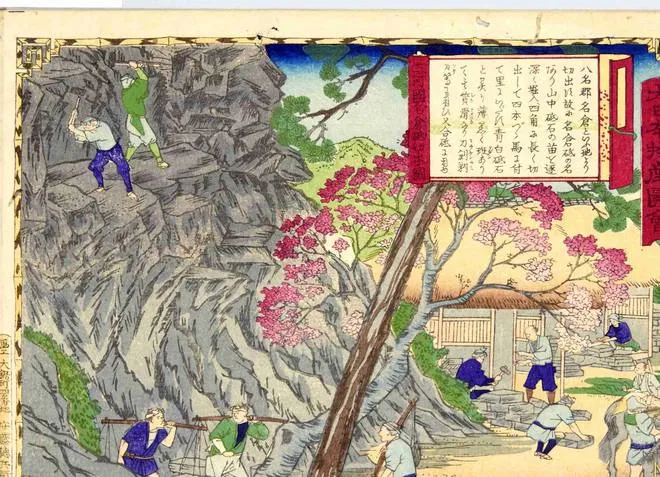
Quarrying Nagura whetstones
The Meiji series Dai-Nippon Bussan Zue set out to record how the country’s goods were made, province by province. This plate shows the cutting of Nagura whetstone in Mikawa: men work the cliff face with pick-hammers, others carry the stone down in shoulder-baskets, and cutters dress it into blocks beside a thatched shed. Nagura is the soft, slurry-raising stone that every fine natural sharpening stone needs — the direct forebear of the whetstone knowledge gathered in this register.
Public domain · Tokyo Metropolitan Central Library · view the original →
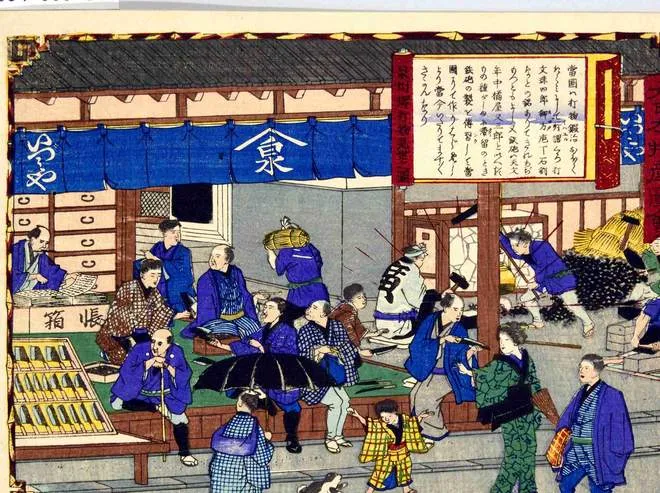
A forged-blade shop in Sakai
From the same series — the shopfront of a forged-blade dealer in Sakai, the great western blade district that, with Sanjō and Miki, framed the wider trade Tokyo’s smiths worked within. Finished blades are racked along the walls while clerks and customers crowd the earthen-floored shop: a rare colour view of how edge tools reached their buyers before the modern hardware store.
Public domain · Tokyo Metropolitan Central Library · view the original →
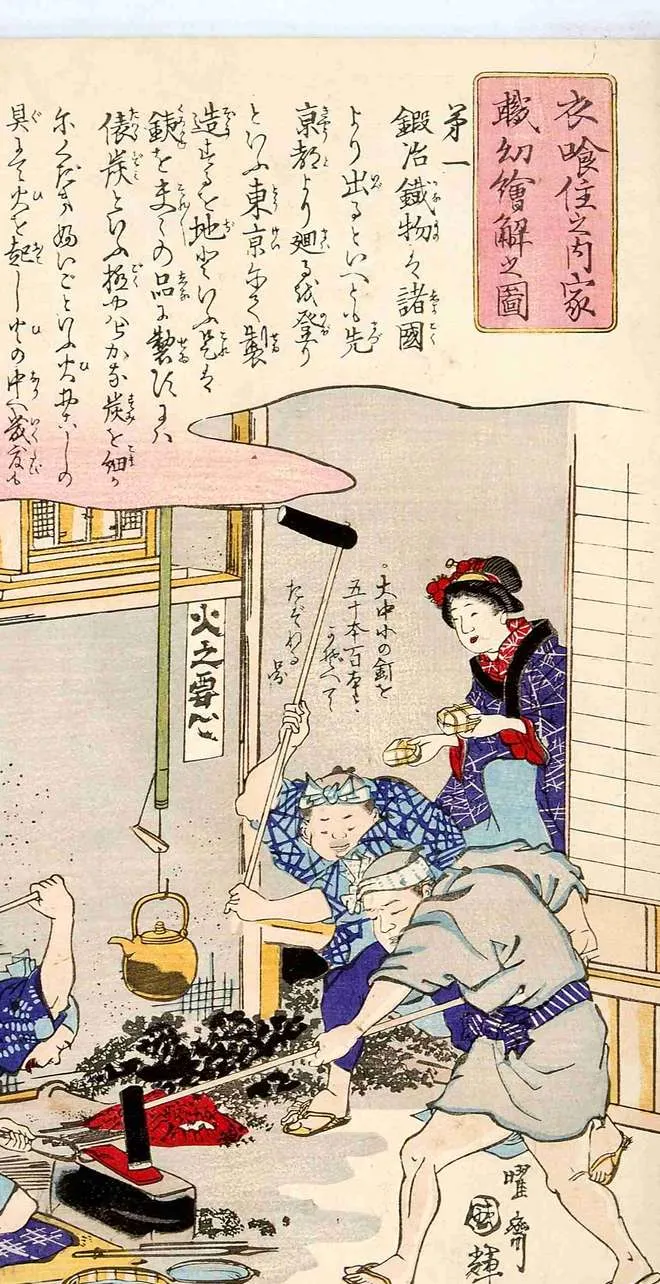
A blacksmith at his forge
Plate one — 「鍛冶鉄物」, smith and ironwork — from a Meiji illustrated primer that taught children the trades of clothing, food, and shelter. A smith draws iron from the fire as an assistant strikes. The scene is idealised for young readers, but it is one of the few period images of a working forge of exactly the kind Tokyo’s tool smiths kept.
Public domain · Tokyo Metropolitan Central Library · view the original →
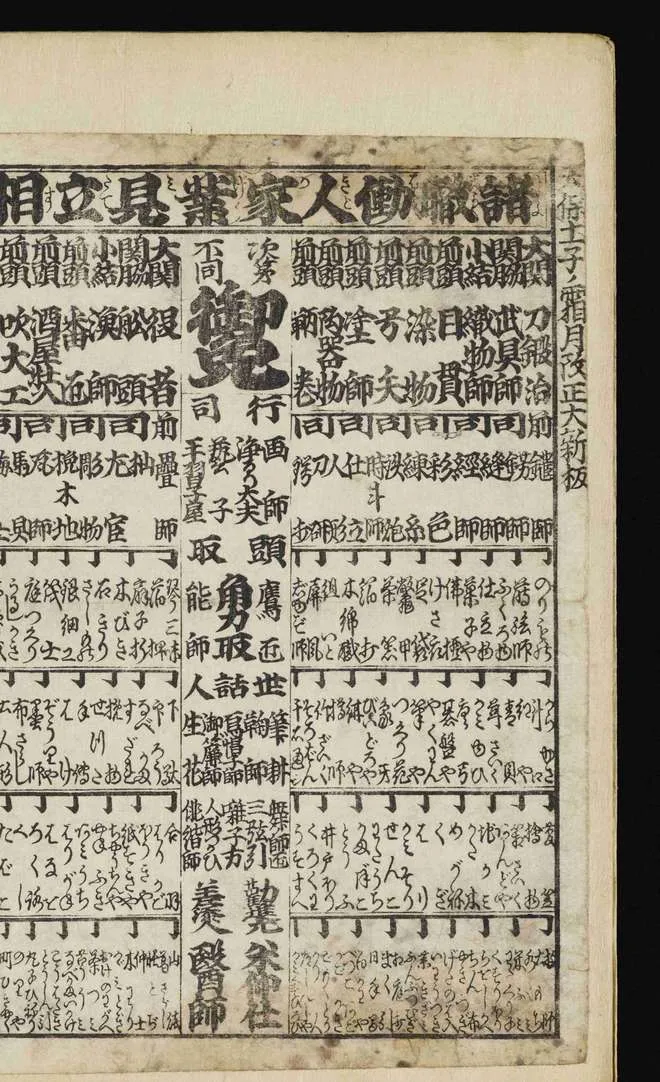
The trades, ranked like sumo
A single Edo broadsheet that grades the working trades as though they were sumo wrestlers — ranked east and west, division by division, with smiths and carpenters taking their place among the crafts. These mitate (‘mock-ranking’) sheets are a vivid, popular record of how Edo saw its own tradespeople, printed for ordinary buyers.
Public domain · Tokyo Metropolitan Central Library · view the original →
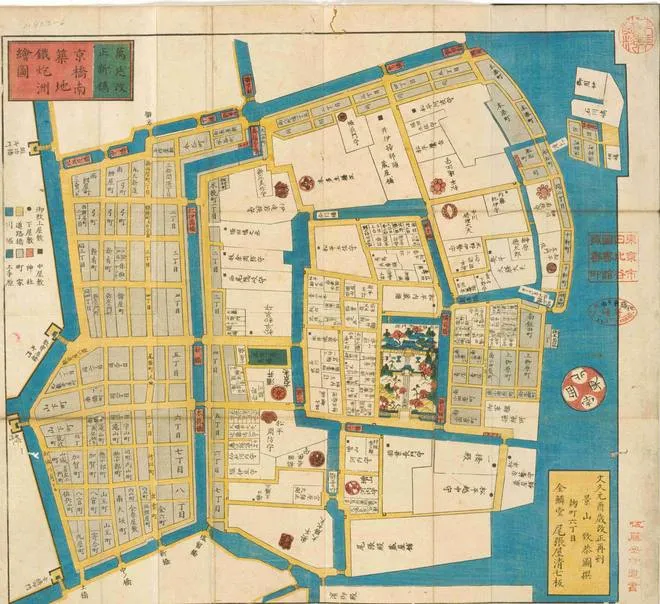
The saw-smith’s neighbourhood, mapped
A 切絵図 — an Edo neighbourhood cut-map — of Kyōbashi-south, Tsukiji, and Teppōzu, its waterways picked out in blue and every block named. This is the ground the saw-smith Nakaya Kyūsaku worked: his shop stood in Kita-Makichō, a short walk from the Ōsakaya wholesale house in Denma-chō that commissioned Takagaki’s saws. A map is the nearest thing to standing where the forges stood.
Public domain · Tokyo Metropolitan Central Library · view the original →
The documentary record
These are the public-domain National Diet Library pages the register itself cites: the trade directories, guild registers, trademark gazettes and biographies that stand behind its claims. Each is shown at the cited page, with a translation of what it records, and links to the original on the NDL.
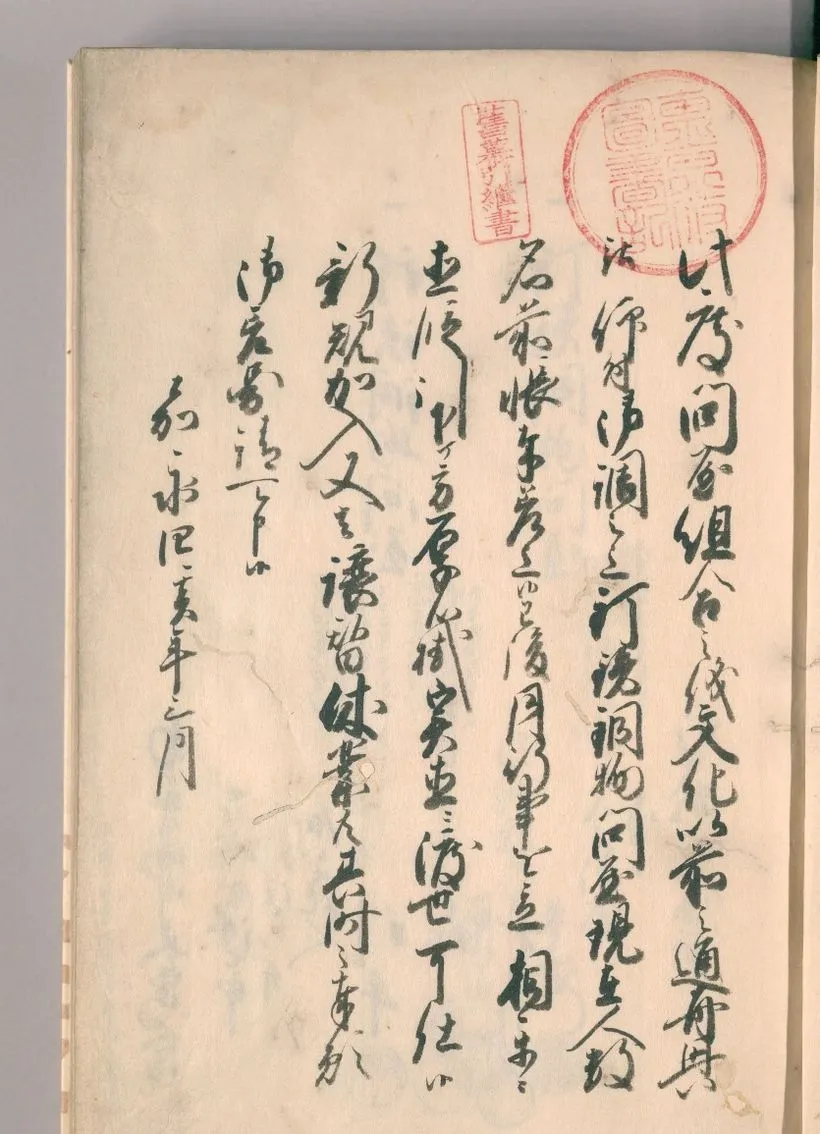
Restoring the wholesalers' guild, 1851
When the Tenpō reforms abolished Edo's licensed wholesaler guilds in 1841, the hardware trades lost their legal footing; a decade later the policy was reversed. This brush-written submission is that reversal for the metal trade: it reports that the wholesalers' guild is to be revived as it stood in earlier years, and returns, on official demand, a fresh register of the names and numbers of the nail, iron and copperware wholesalers (釘鉄銅物問屋, kugi-tetsu-dōmono-don'ya). Dated the third month of Kaei 4 (1851), it is the kind of ten-guild record from which this register traces the Edo roots of the tool trade.
Public domain · National Diet Library, 諸問屋名前帳 · view on the NDL →
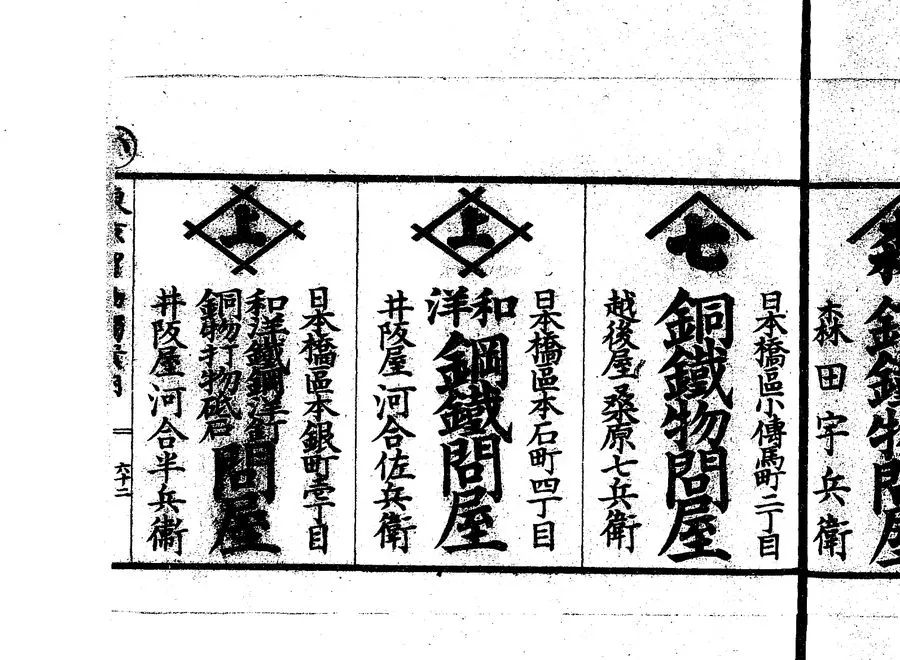
The Kawai steel house, before Tōgō
Two decades before the "Tōgō Steel" brand made the house famous, this illustrated shoppers' guide lists the Kawai family plainly among the copper and iron wholesalers of Nihonbashi. Under the diamond 井 (i) shop-mark trade two kin: 井阪屋 河合佐兵衛 (Isaka-ya Kawai Sabei), a dealer in Japanese and Western steel, and 井阪屋 河合半兵衛 (Kawai Hanbei), in iron and forged goods, both in Honshirogane-chō. It is the same house that reappears in this register as the Tōgō-steel firm.
Public domain · National Diet Library, 東京買物独案内 · view on the NDL →
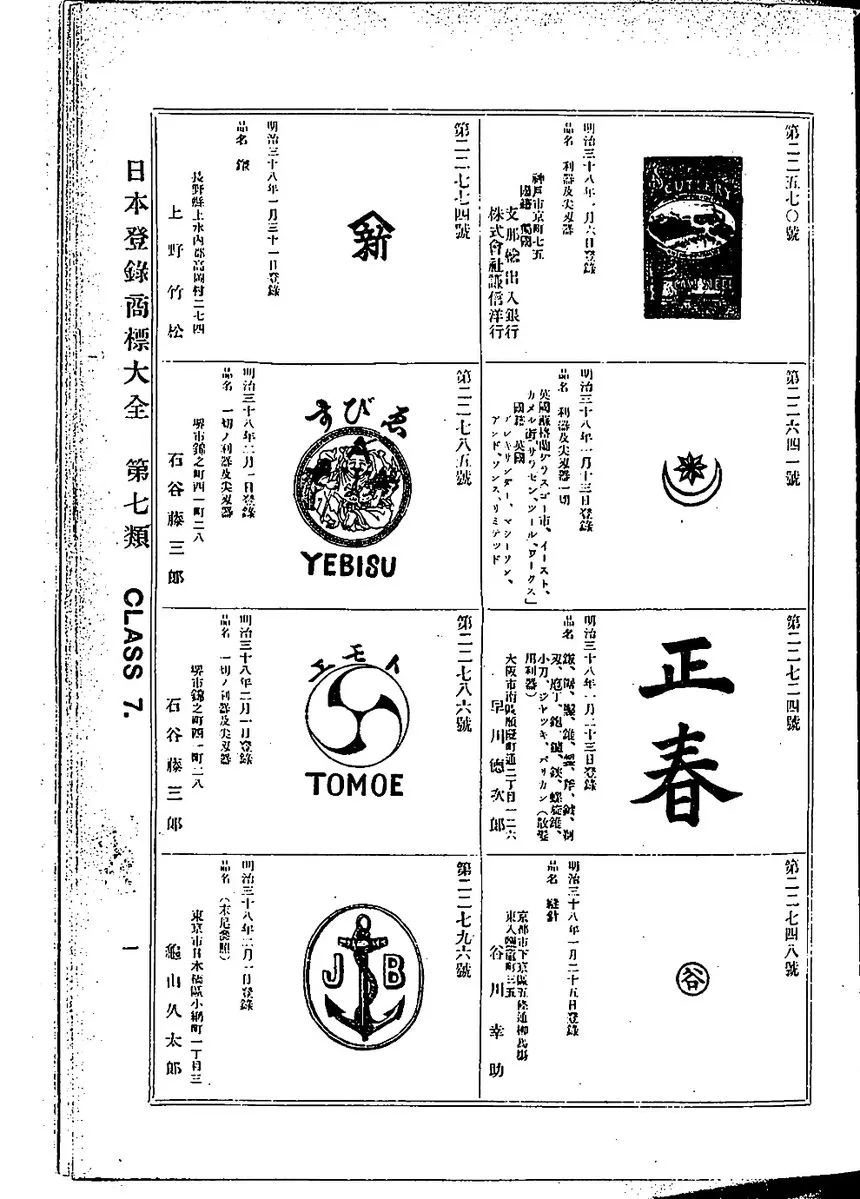
Edge-tool marks, as registered
This register attributes many blades to their marks; this is where the marks became law. It is a page of Class 7, 利器及尖刄器 (riki oyobi senjōki, edge tools and pointed blades), from the official trademark compendium: each cell a registered mark with its drawing, number, date, owner and address. The marks shown, among them YEBISU, the TOMOE triple-comma, an anchor over J.B, and 正春 (Masaharu), were registered in January 1905 to edge-tool houses in Sakai, Tokyo and Osaka. It is the primary-source layer beneath every attribution of a mark in this register.
Public domain · National Diet Library, 日本登録商標大全 第七類 · view on the NDL →
A whole town of toolmakers: Yoita
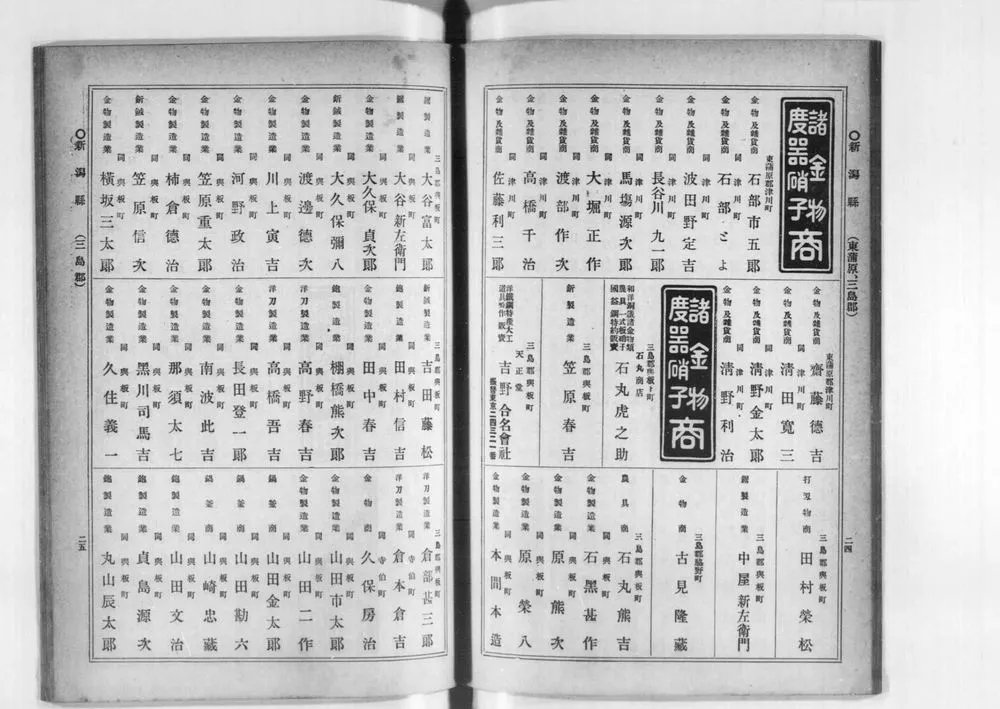
The Tokyo smiths drew steel, stock and men from the provincial tool towns, and none looms larger than 與板 (Yoita) in Niigata. This directory page is column after column of Yoita makers, each tagged by craft: 鉋製造業 (kanna, plane-makers), 鋸製造業 (nokogiri, saw-makers), 釿製造業 (chōna, adze-makers), 金物製造業 (kanamono, hardware-makers). Among them is 横坂三太郎 (Yokosaka Santarō), a Yoita name that recurs in this register's own lineages.
Public domain · National Diet Library, 東洋金属名鑑 · view on the NDL →
The hardware guild, on the record
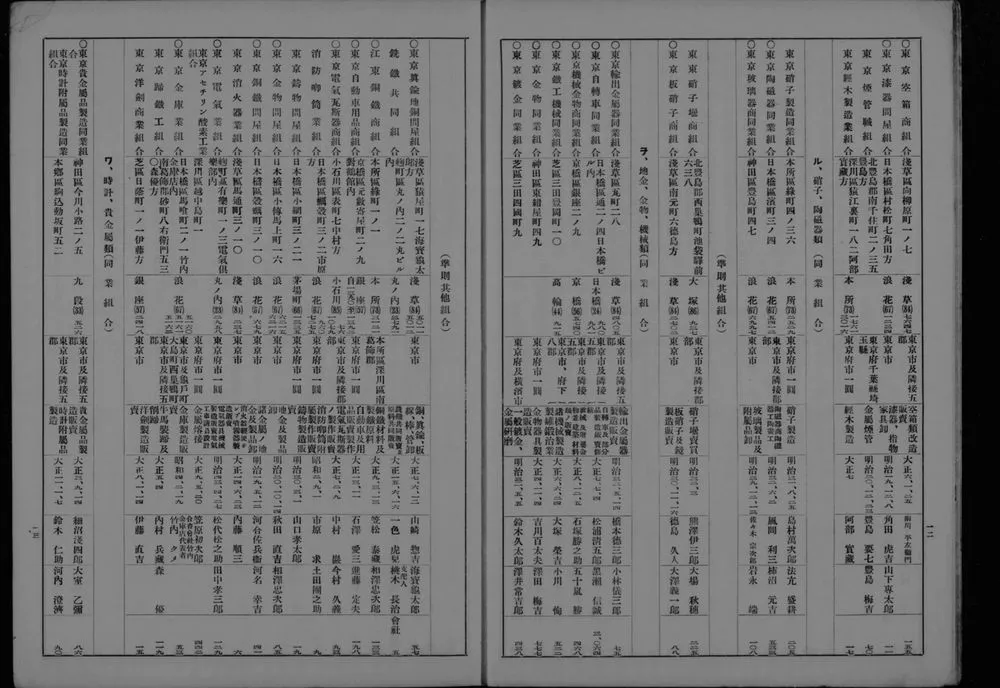
Here is the 東京金物同業組合 (Tōkyō Kanamono Dōgyō Kumiai, Tokyo Hardware Trade Guild) in an official register, one row in a long table of the city's trade bodies. It gives the guild's office at Kanda Higashi-Kon'yachō 49, its jurisdiction as the whole of Tokyo, its scope as the manufacture and sale of hardware, and its founding as 4 November 1915. The same table lists the neighbouring bodies the register's houses moved among: the machine-hardware dealers, the copper-and-iron wholesalers, the casting trade. It is the documentary backbone of the register's guild feature.
Public domain · National Diet Library, 東京市産業関係団体便覧 · view on the NDL →
How a steel got the admiral's name
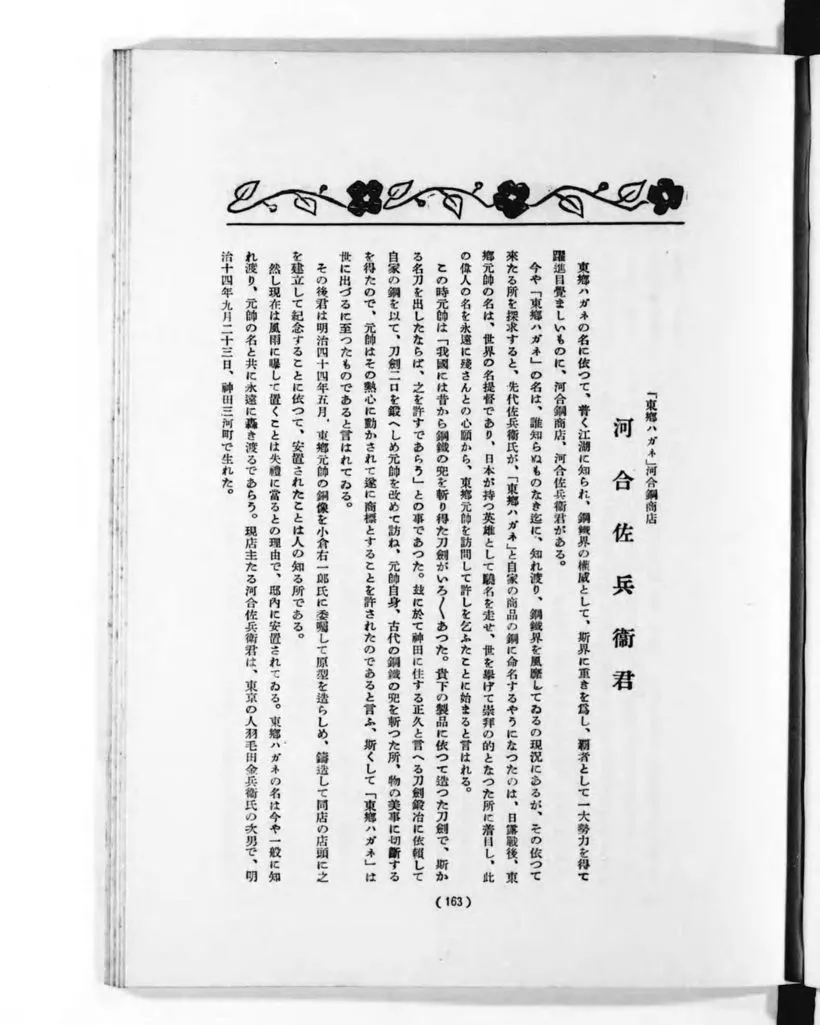
This who's-who page carries the fullest telling of how 河合佐兵衛 (Kawai Sabei) branded his steel "Tōgō Hagane" after Admiral Tōgō, hero of the Russo-Japanese War. Wishing to preserve the admiral's name, the elder Sabei called on him for leave. Tōgō replied that Japan's old swords could cut through steel helmets, and that if a blade of this steel could do the same he would consent; so a Kanda swordsmith named Masahisa (正久) forged two swords from it, the admiral himself cut an antique helmet clean through, and gave his blessing. The entry adds the house's standing: Sabei, born 1881, a Chamber of Commerce councillor who set a bronze Tōgō at his shopfront and, in 1930, received the Swedish Order of Vasa.
Public domain · National Diet Library, 現代業界人物集 · view on the NDL →
The edge-tool wholesalers, listed
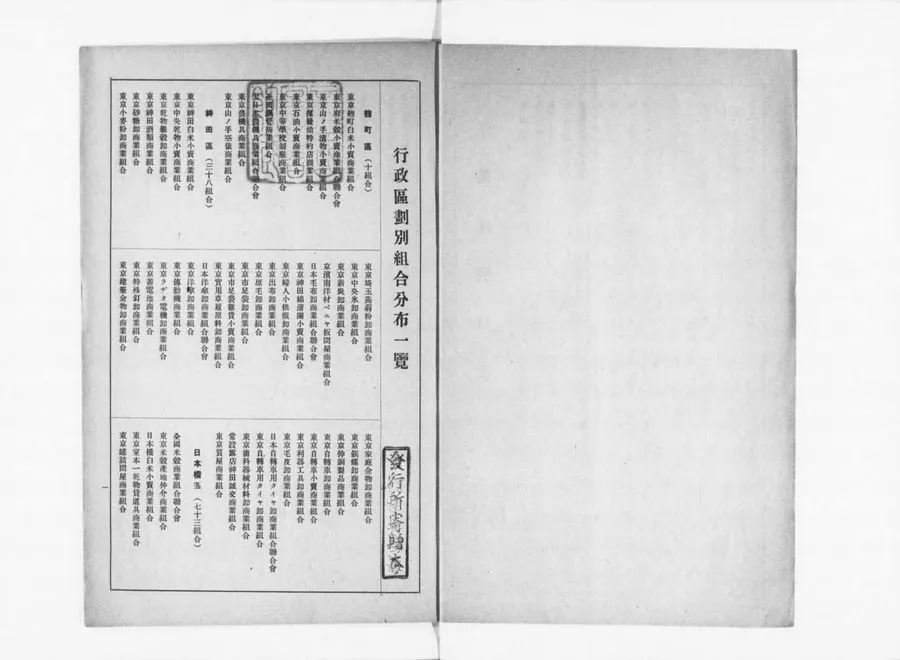
By 1940 the edge-tool trade had a standalone body of its own, and here it is in the city's guild survey, arranged ward by ward: among the Nihonbashi guilds sits the 東京利器工具卸商業組合 (Tōkyō Riki-Kōgu Oroshi Shōgyō Kumiai, Tokyo Edge-Tool Wholesalers' Guild), beside the building-hardware, household-hardware and other metal-trade guilds. It is the roster layer behind the register's account of how Tokyo's edge-tool trade organised itself.
Public domain · National Diet Library, 東京市商業・工業・貿易組合一覧 · view on the NDL →
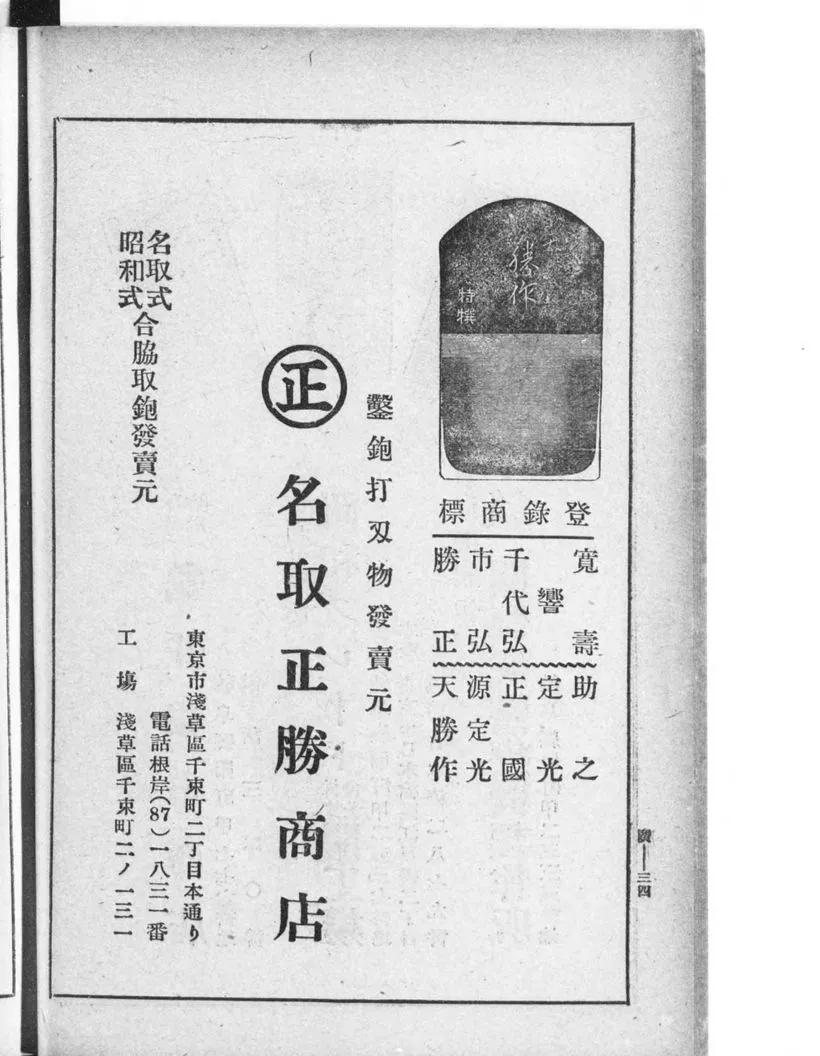
One shop's wall of marks
A wartime advertisement for 名取正勝商店 (Natori Masakatsu Shōten) of Asakusa, a wholesaler of chisels, planes and forged edge-tools. Beneath the shop's circled-正 mark runs a grid of the registered trademarks it sold under: 寿, 響, 千代弘, 市弘, 源定, 正光, 正國, 定光, 天勝, 勝作. One of them, 市弘 (Ichihiro), is a smith tracked elsewhere in this register: in a single advertisement, the proof of how one wholesaler gathered many smiths' marks under a single roof.
Public domain · National Diet Library, 金物便覧 · view on the NDL →
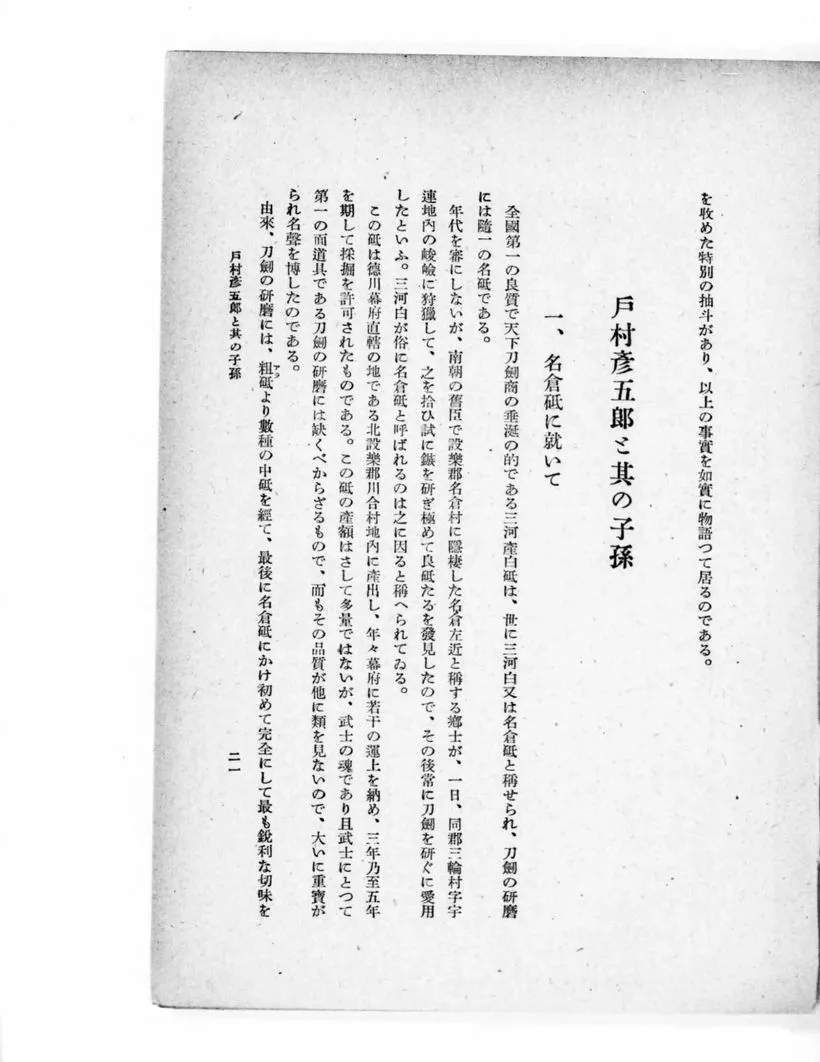
The stone every edge needs
No plane or chisel is finished without a fine natural stone, and the finest slurry-stone of all was the 名倉砥 (Nagura-to) of Mikawa. This page opens the account of the 戸村 (Tomura) family who worked it: found, by tradition, when a masterless samurai ground an arrowhead on a rock while hunting; quarried in Kawai village under direct Tokugawa control, for a small yearly tribute and under three-to-five-year licences; and indispensable to the finish of a blade, taken up only at the last stage, after the coarse and middle stones. It is the source behind the register's whetstone-supply story.
Public domain · National Diet Library, 東三河産業功労者伝 · view on the NDL →
Facsimiles courtesy of the Tokyo Metropolitan Central Library digital archive. See also the 1879 saw-smith facsimile on the register.